

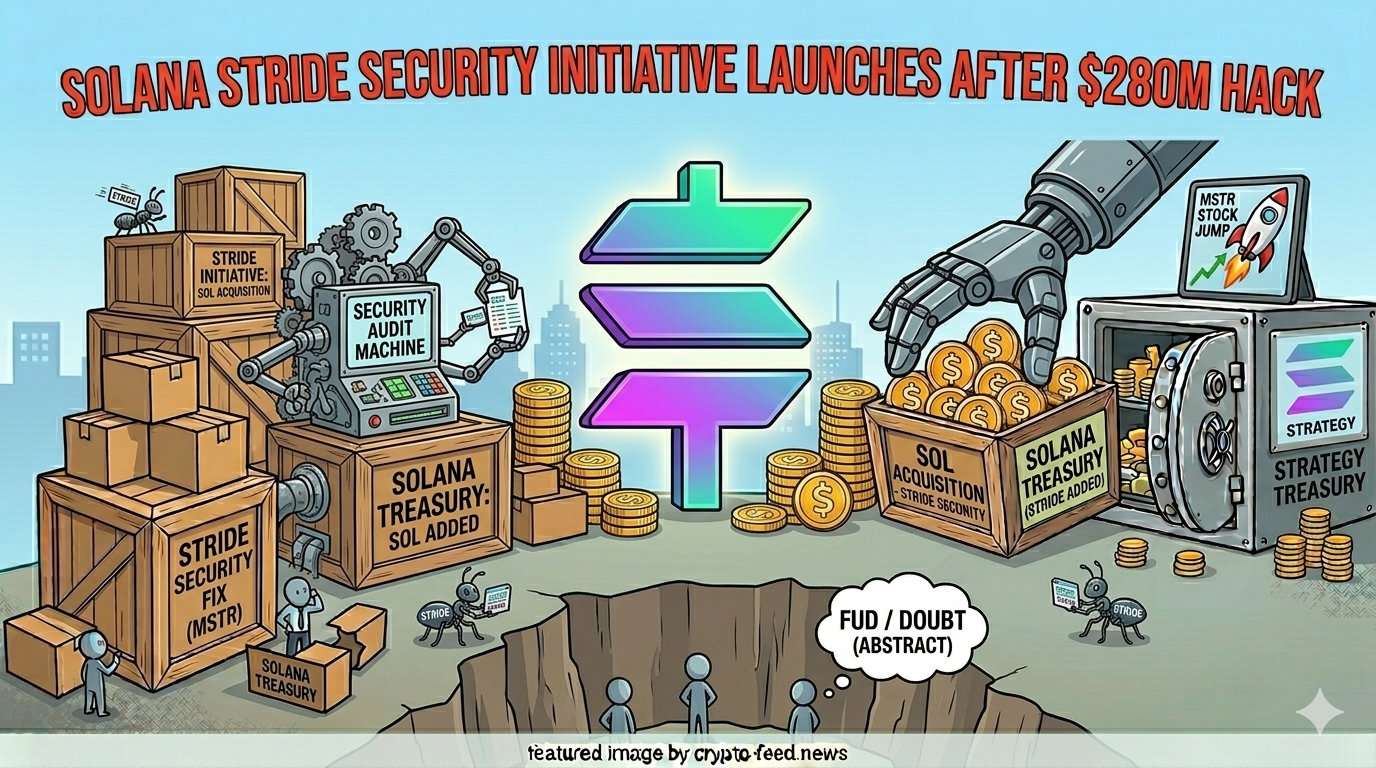
The Solana STRIDE security initiative is now live. Unveiled on Monday by the Solana Foundation and Asymmetric Research, STRIDE stands for Solana Trust, Resilience and Infrastructure for DeFi Enterprises. It’s a structured program to evaluate, monitor, and escalate security across Solana-based protocols.
Why now? Because adversaries are “rapidly innovating.” Just last week, the Drift Protocol lost roughly $280 million in a North Korean-linked social engineering attack. That followed a $40 million drain on Step Finance in January, where AI agents amplified the damage by autonomously executing large transfers.
What the Solana STRIDE Security Initiative Covers
STRIDE assesses protocols across eight critical pillars:
- Program security
- Governance and access control
- Oracle and dependency risk
- Infrastructure security
- Supply chain security
- Operational security
- Monitoring and incident response
- Log management and forensics
Findings are published publicly. That means users, investors, and the broader ecosystem get real transparency into the security posture of the protocols they interact with.
Incident Response Network Launches Alongside STRIDE
The Solana Foundation also announced the Solana Incident Response Network (SIRN). It’s a network of security firms dedicated to real‑time incident response. Members will share threat intelligence, coordinate responses to active attacks, and help evolve the STRIDE framework over time.
This matters because the threat landscape is brutal. In Q1 2026, attackers stole over $168 million from 34 DeFi protocols, according to DefiLlama. While that’s down from $1.58 billion in Q1 2025, the sophistication of attacks “like the Drift social engineering op” is rising fast.
My Thoughts
This is exactly what Solana needed. The Drift hack exposed a painful truth: social engineering and compromised private keys remain the industry’s Achilles’ heel. STRIDE’s public audit framework is a game‑changer. By forcing protocols to publish security findings, it creates accountability. No more “trust us, we’re secure.” The SIRN network is equally critical, real‑time coordination could stop attacks before they cascade. However, execution is everything. Will protocols actually adopt STRIDE? Will SIRN members share intel fast enough? I’m cautiously optimistic. If Solana pulls this off, it could become the gold standard for DeFi security. For traders, this reduces long‑term risk. Short term? Watch for protocols that fail STRIDE audits – they could see sharp outflows.