


The market got what it asked for—and it’s not helping. A weaker-than-expected jobs report would normally spark rate-cut speculation and send risk assets soaring. But in today’s macro environment, the reaction is muted. Bitcoin hovers near $70,000, and traders are left parsing a paradox: weaker jobs + oil shock = Fed trap, not green light .
The Bitcoin Jobs Report Analysis: Why Good News Is Bad News
Let’s break down the mechanics. The jobs miss theoretically increases the probability of rate cuts later this year . Weaker labor market = less inflationary pressure = room for the Fed to ease. That’s the textbook playbook.
But here’s the twist: an oil-driven inflation squeeze is complicating the narrative. With the Strait of Hormuz embargo disrupting 20% of global oil transit, energy prices are spiking . Food costs are following. This creates sticky headline inflation even as the economy slows.
The Fed’s dilemma is now acute. If growth slows but inflation remains elevated due to supply shocks, their room to ease aggressively shrinks . They’re trapped between a weakening economy and persistent price pressures.
Bitcoin’s Narrative Trap: Digital Gold vs. Risk Asset
This macro cocktail is uniquely toxic for Bitcoin. When the Fed can’t cut, the “digital gold” narrative struggles to gain traction. Yet Bitcoin also can’t fully escape its correlation with tech and high-beta assets during de-risking events.
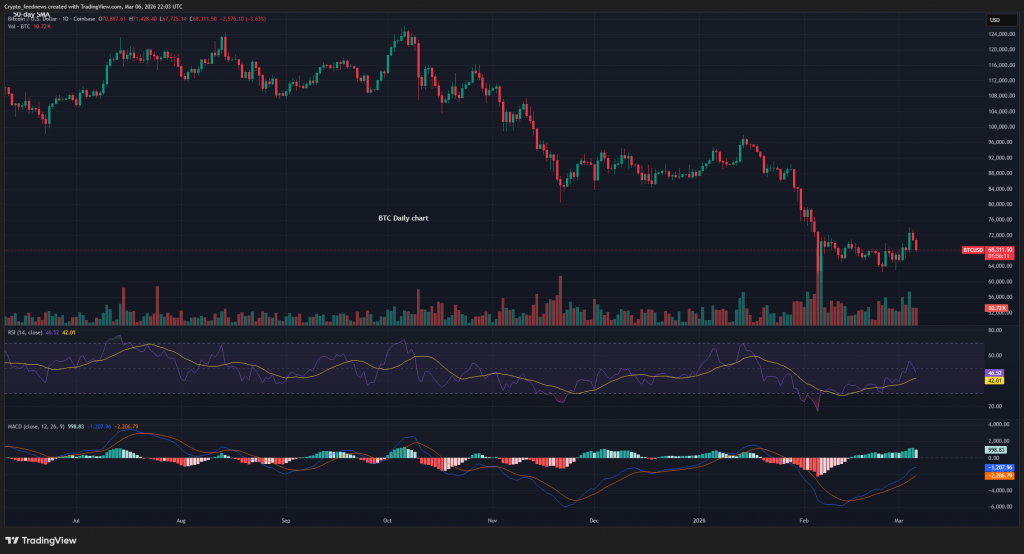
The result? BTC is under $70,000, unable to break decisively higher despite the jobs miss. Traders are treating this less as a green light to lever up and more as another stress signal in a regime defined by war-driven oil shocks, fragile credit, and a Fed that cannot yet declare victory .
My Thoughts
This Bitcoin jobs report analysis reveals the uncomfortable truth: we’re in a no-win macro regime for risk assets. Good news (strong economy) means no cuts. Bad news (weak jobs) means stagflation fears. There’s no clean catalyst.
The oil shock is the wildcard. If the Strait of Hormuz remains closed, energy-driven inflation could persist for months. That keeps the Fed hawkish even as growth slows—the worst of both worlds.
For Bitcoin, this means range-bound trading until the macro fog clears. $65,000–$75,000 is the new reality. Breakouts require either a de-escalation in the Middle East (easing oil shocks) or a clear signal from the Fed that cuts are coming despite inflation.
Until then, traders should manage risk, avoid leverage, and wait for conviction. The setup will resolve—but not yet.