


The missiles flew, but Bitcoin didn’t flinch. In a stunning display of resilience, Bitcoin price war reaction has been remarkably calm despite the escalating US-Iran military conflict. BTC trades near $68,300, up 1.3% on the day and holding near the top of its weekly range between $62,900 and $69,300 . This isn’t the panic-driven sell-off we’ve seen in previous geopolitical flashpoints—it’s something different entirely.
Decoding Bitcoin’s Price War Reaction: Short-Term Holders Stay Calm
The key metric telling this story? Short-term holder behavior. According to a March 1 CryptoQuant analysis, the Short-Term Holder P&L to Exchanges metric shows a dramatic shift . During the Feb. 5–6 market drop, roughly 89,000 BTC were sent to exchanges at a loss within 24 hours—a textbook capitulation event .
But here’s the alpha: during this week’s Iran strike, exchange inflows from short-term holders did not spike . No surge in panic selling. No aggressive profit-taking. The weak hands that were going to sell have already sold.
This matters because markets often stabilize once forced sellers exit. The data suggests the recent liquidation pressure may have already played out .
Technical Levels: The $70,000 Wall
Bitcoin currently trades at $68,308, with Bollinger Bands showing immediate resistance at the upper band near $70,100 . The middle band sits at $67,300, which BTC has reclaimed after touching the lower band near $64,400 during the dip .
The RSI has climbed from oversold levels in the low 20s to around 47 . Momentum is improving, but it hasn’t crossed above 50—the level associated with stronger buyer control .
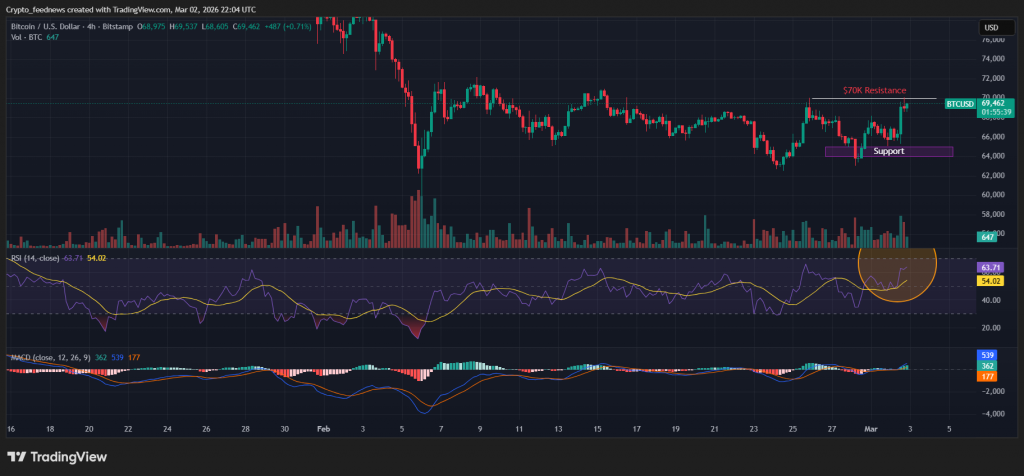
The structure resembles a sharp impulse lower followed by sideways compression, which could resolve as either a bear flag (targeting low $60Ks) or a consolidation before upside . A daily close above $70,000 would shift momentum bullishly. Failure to hold $64,000–$65,000 support opens a path to $60,000 .
My Thoughts
This Bitcoin price war reaction is the most significant data point of the week. In previous geopolitical flashpoints, BTC sold first and asked questions later. This time, short-term holders showed remarkable restraint.
Why? Because the panic selling already happened. The 89,000 BTC capitulation in early February cleared out the weakest hands . What’s left are holders with stronger conviction—or simply those already underwater who see no point in selling here.
The $70,000 level now becomes the ultimate test. If BTC can push through with volume, it would confirm that the selling pressure is truly exhausted. If it rejects, we’re likely looking at more consolidation between $64K and $69K.
For investors, this is the definition of a structural floor forming. War headlines create volatility, but they don’t change the adoption curve. Smart money accumulates when weak hands panic. The weak hands have already panicked.