


The inflation fight just got harder. December PCE inflation data came in hotter than expected, with the Fed’s preferred gauge rising to 2.9% year-over-year versus the 2.8% forecast. The PCE inflation data Bitcoin reaction was immediate and brutal: BTC slumped below $67,000 to trade near $66,700 at press time. Rate cut expectations are now firmly on ice.
Breaking Down the Hot PCE Inflation Data
The Bureau of Economic Analysis delivered a one-two punch:
- Headline PCE: 2.9% YoY (vs. 2.8% expected); 0.4% MoM (vs. 0.3%)
- Core PCE: 3.0% YoY (vs. 2.9% expected)—highest since November 2023; 0.4% MoM (vs. 0.3%)
This marks an acceleration from November’s 2.8% reading, confirming that disinflation has stalled—or reversed. For the Fed, this is a red flag. FOMC minutes already showed officials favoring a “hold” stance; this data makes any near-term cut virtually impossible. Some hawks may even whisper about rate hikes if inflation persists.
Bitcoin’s Reaction and the Macro Double-Whammy
The PCE inflation data Bitcoin price drop was exacerbated by concurrent Q4 GDP data, which came in at a dismal 1.4% —far below the 2.8% forecast and a sharp deceleration from the prior 4.4%. This combination—sticky inflation + weakening growth—is the worst of both worlds for risk assets. It suggests the economy is slowing, but not enough to cool prices, leaving the Fed trapped.
My Thoughts
This is the macro nightmare scenario for crypto. Hot PCE inflation data Bitcoin correlation remains tight—when inflation surprises to the upside, BTC sells off. The GDP miss adds insult to injury, creating a stagflation-lite environment that offers no clear path for the Fed.
Bitcoin’s drop below $67,000 is technically significant. The next support is the $65,000-$66,000 zone; a break there could accelerate toward $60,000. Resistance now sits at the lost $68,000 level.
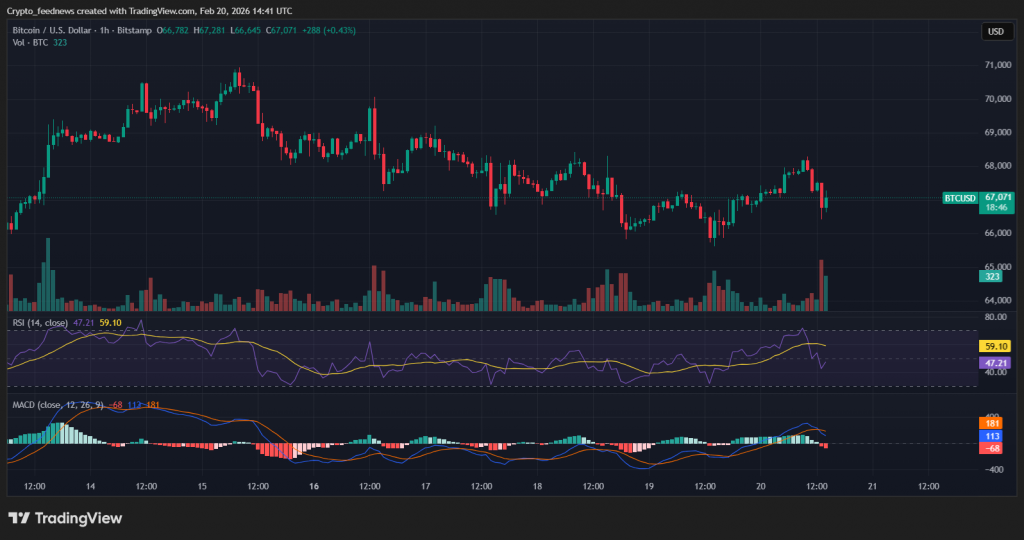
For investors, this is a patience test. The Fed won’t save us anytime soon. But crypto has survived multiple tightening cycles. The key is positioning defensively and waiting for the next catalyst—whether that’s institutional accumulation, ETF flow reversal, or simply time healing the chart structure.