


The CEO of a major asset manager just made a bold declaration. Jan Van Eck, CEO of VanEck, has issued a definitive Bitcoin bottom call, stating that the leading cryptocurrency is “making a bottom” after its brutal drawdown from October’s all-time highs . His reasoning? The four-year halving cycle is playing out exactly as history suggests.
The Bitcoin Bottom Call: Four-Year Cycle Logic
In a CNBC interview, Van Eck laid out his thesis with refreshing simplicity . “There’s been an investing cycle—Bitcoin goes up three years in a row, goes down pretty massively in that fourth year,” he explained. “2026 is that fourth year. So that’s why we are in a Bitcoin bear market. Now I think we are making a bottom” .
He emphasized that recent price action has been driven by this cyclical pattern rather than fundamental deterioration. The $126,000 peak in October 2025 was always going to be followed by a corrective phase—and that’s exactly what we’ve witnessed .
$458 Million ETF Inflows Support the Thesis
Timing is everything, and the market is providing powerful confirmation. Spot Bitcoin ETFs recorded $458.2 million in net inflows on Monday, with BlackRock’s IBIT capturing $263.2 million of that total . No funds experienced outflows—a clean sweep of institutional demand .
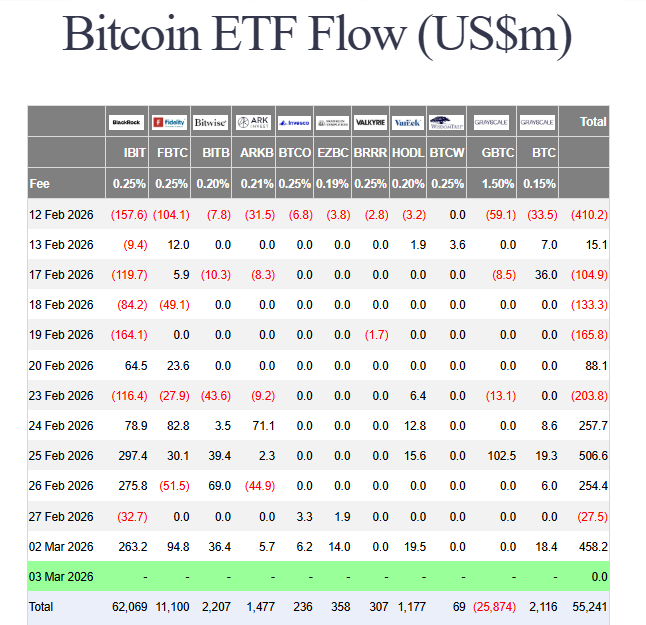
This follows a broader trend shift. After five consecutive weeks of redemptions draining nearly $4 billion, last week saw $787 million in inflows, decisively ending the outflow streak . Analysts at LVRG Research noted that “major allocators appear to view current price levels as an attractive entry point amid Bitcoin’s recent correction and stabilization” .
Geopolitical Paradox: Institutions Buy Into Chaos
The inflows are arriving despite—or perhaps because of—escalating US-Iran tensions following joint military strikes . Bitrue’s research lead explained that institutions “seized dip opportunities rather than waiting for de-escalation, as structural ETF flows and resilience trumped waiting for perfect clarity” .
This marks a maturation point. Bitcoin is being treated as a portfolio diversifier and potential hedge, not just a speculative toy .
The Four-Year Cycle Debate
Not everyone agrees with Van Eck’s framework. Critics argue that institutional adoption, ETF infrastructure, and shifting global liquidity conditions have rendered the four-year cycle obsolete . Grayscale previously stated they don’t believe in the cycle narrative, predicting new all-time highs for 2026 .
However, Kaiko research supports Van Eck’s view, noting that the post-peak drawdown from $126,000 to the $60,000–$70,000 range “aligns with the corrections seen during previous bear phases” .
My Thoughts
A Bitcoin bottom call from the CEO of a major ETF issuer carries weight. Van Eck isn’t just theorizing—his firm manages $181 billion and has skin in the game with their own Bitcoin ETF .
The confluence of factors is compelling: historical cycle alignment, resurgent ETF inflows, institutional buying during geopolitical stress, and exhausted selling pressure from short-term holders. February’s 89,000 BTC capitulation event likely marked the final flush of weak hands .
CryptoQuant data suggests bottoms “take time” to form, with potential bottom windows between June and December 2026 . But the foundation is being laid now. When institutions buy during war, they’re signaling long-term conviction, not short-term trading.
For investors, this is the accumulation zone. The four-year cycle has repeated with remarkable precision. If history holds, 2026 is the year of bottoming—and 2027 will reward those who had the conviction to buy when CEOs called the bottom and ETFs flooded back in.