

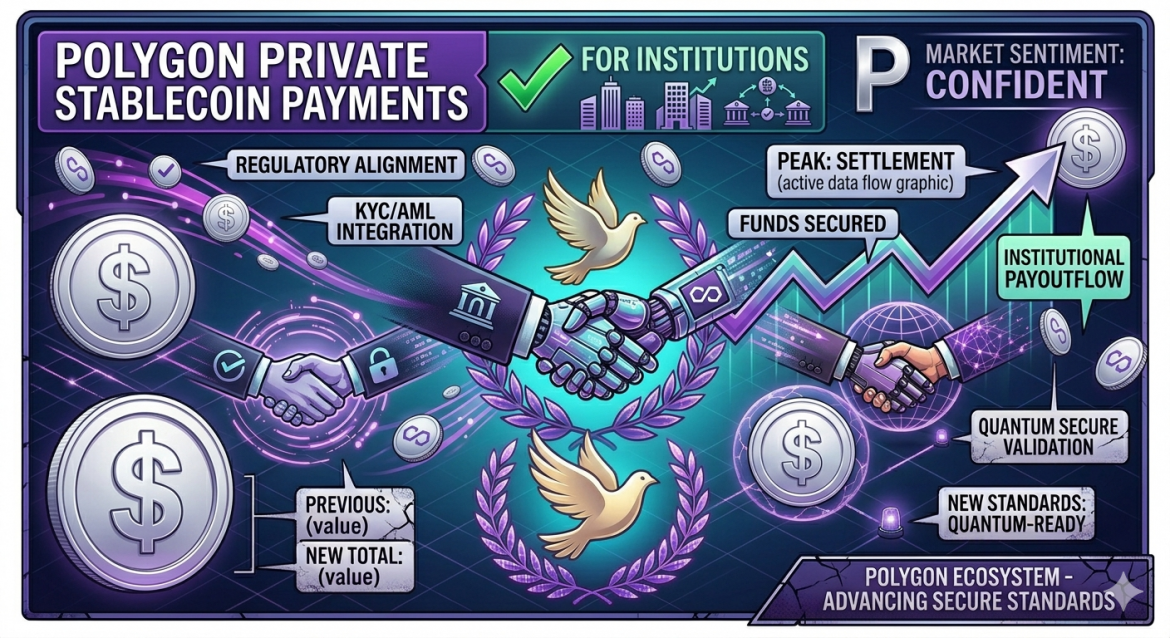
Polygon just launched a new wallet feature for private stablecoin payments.
Why does this matter? Because businesses want privacy. But not the kind that hides from regulators.
The new feature hides senders, receivers, and transaction amounts onchain. At the same time, it stays compliant thanks to Know Your Transaction (KYT) screening and auditable files.
How Polygon private stablecoin payments work
Polygon announced this on Sunday. The feature lets users route transactions through a shielded pool. Zero-knowledge proofs handle the verification.
This is part of an integration with privacy protocol Hinkal.
As Polygon community lead Smokey explained on X: “For onchain payments to go mainstream, businesses need privacy. Not ‘hide from regulators’ privacy. Operational privacy.”
Why Polygon private stablecoin payments matter for institutions
Privacy was one of the biggest crypto themes in 2025. Many privacy-focused assets surged last year, even during a broader market downturn.
Polygon argues that most institutions won’t move serious volume onchain without confidentiality.
“Confidentiality has been the single biggest gap between onchain rails and what institutional finance actually needs to move serious stablecoin volume,” Polygon said.
The team added: “Banks, treasuries and payments teams already live with confidentiality on traditional rails. They won’t move operational flows onto a ledger that broadcasts every counterparty and every amount to every observer on the network.”
Compliance comes first
Polygon’s new feature hides transactions from the public. However, it still allows compliance and auditability.
As Polygon put it: “Privacy means opacity to the market, not opacity to regulators.”
This works in two ways. First, every private transaction on Polygon passes through KYT screening before execution. Second, users can generate audit files. These files can be handed over to tax officials or regulators, according to Hinkal’s documentation.
Other chains are following the same path
This move comes just weeks after Aptos launched its own privacy feature. On April 24, the layer-1 blockchain introduced the Confidential APT coin.
That coin is pegged to the Aptos (APT) token. It also uses zero-knowledge proofs to hide and verify transfer information.
Stablecoins are growing fast on Polygon
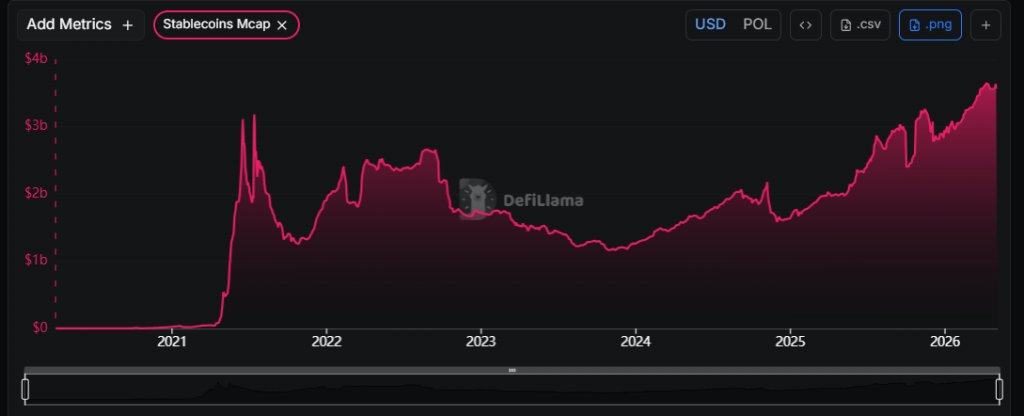
According to DefiLlama, the total market cap of stablecoins on Polygon hit an all-time high of $3.6 billion on April 10. That makes Polygon the eighth-largest stablecoin chain.
Interest in stablecoins has grown since the U.S. passed the GENIUS Act last July. The law is stablecoin-friendly and sparked more trading volume.
Just on Sunday, Western Union became the latest traditional finance firm to launch a stablecoin. It introduced USD-pegged USDPT on Solana.