


Institutional Sentiment Shifts as Bitcoin ETF Outflows Mount
The tide is turning for institutional Bitcoin demand—at least for now. Spot Bitcoin ETFs bled another $277 million in net outflows on December 16th, marking a second consecutive day of significant withdrawals. This wave of Bitcoin ETF outflows, led by BlackRock’s IBIT, signals a clear cooldown in institutional sentiment amidst a broader market correction, with BTC price hovering around $86,500.
Breaking Down the ETF Exodus
BlackRock’s iShares Bitcoin Trust (IBIT) dominated the exits with a single-day outflow of $210 million. Bitwise’s BITB followed, shedding $50 million. Notably, Fidelity’s FBTC was the sole fund to see positive inflows ($26.7M), but it was a drop in the bucket against the broader tide.
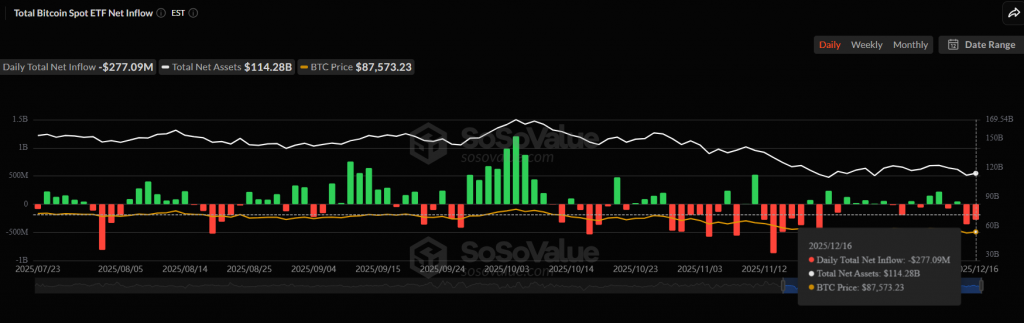
The data reveals a stark two-month trend. Total Assets Under Management (AUM) for all Bitcoin ETFs have plummeted from ~$169.5 billion to ~$120.7 billion. Analyst reports highlight that November alone saw nearly $3.8 billion in net outflows, with IBIT accounting for a massive portion. This isn’t random retail fear; this is structured institutional profit-taking and risk management.

Long-Term Holders Join the Selling Spree
The pressure isn’t just from ETFs. On-chain data shows long-term holders (LTHs)—investors holding BTC for over 155 days—are actively locking in profits. CryptoQuant notes one of the largest LTH sell-offs in the past five years, a behavior typically associated with market highs, not panic capitulation. This suggests a coordinated de-risking by the most seasoned hands in the market.
Macro Storms on the Horizon
All eyes now turn to major macroeconomic events that could fuel further volatility. The upcoming US CPI data and a highly anticipated Bank of Japan (BoJ) rate hike are key catalysts. Historically, BoJ rate hikes have triggered sharp 23-31% Bitcoin drawdowns, adding a layer of macro fear to the current technical and on-chain weakness.
My Thoughts
This is a healthy, albeit painful, market cleanse. ETF flows are a real-time sentiment gauge, and the message is clear: institutions are reducing exposure after a massive run. Combined with LTH selling, this creates significant overhead supply. The path of least resistance remains lower until these macro events pass and we see a stabilization in both ETF flows and on-chain holder behavior. This is a period for caution, not FOMO.