


Ethereum under pressure continues as sellers maintain control. ETH traded at $1,686.49 at the time of publication, down 3.32% over 24 hours and 4.25% over seven days.
According to TradingView data, ETH showed 24‑hour volume at $12.36 billion, with the token moving between $1,683.78 and $1,773.96 during the session. The move replaced the earlier $1,719 level with a weaker market reading. Consequently, ETH’s market capitalization stood near $203.48 billion, showing that sellers still had control even as some analysts watched the same support area for a possible rebound.
Why Ethereum under pressure persists
The weakness did not limit itself to ETH. For example, XRP traded near $1.10, while Solana was close to $70.06 and Hyperliquid traded near $63.73. Dogecoin fell to about $0.080 and lost more than 8% over seven days. However, Tron was one of the rare green assets, trading near $0.331 after gaining 0.47% in 24 hours and 4.15% over the week.
ETF flows and macro headlines weigh on demand
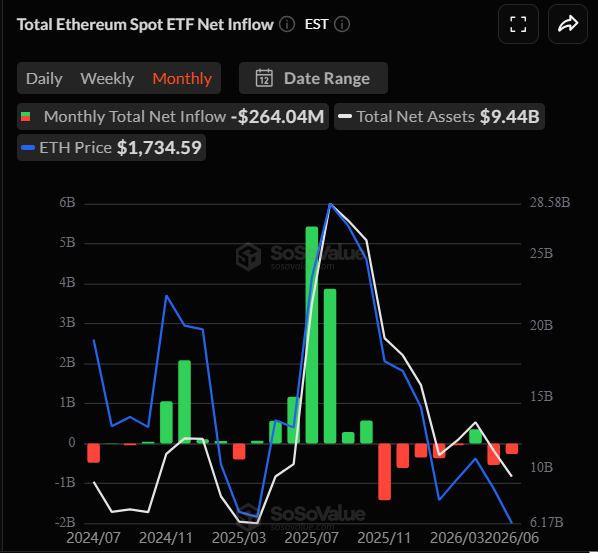
According to SoSoValue data, Ethereum spot ETFs recorded a total net outflow of $66.04 million. Meanwhile, 21Shares′ TETH posted the largest single‑day net inflow at $346,100. The mixed fund data showed that demand remained uneven, with one product attracting a small inflow while the wider ETF group lost capital.
Reports shows that U.S. spot Ethereum ETFs recorded $540.9 million in net outflows in May and another $131.5 million in June at that time. Those withdrawals have reduced one source of steady demand while ETH has continued to trade near lower support levels.
Geopolitical headlines also kept traders cautious. Recent coverage linked crypto moves to U.S.-Iran talks, oil policy, and changing risk appetite. Iran said no nuclear commitments had been made, despite U.S. claims around inspections.
T
herefore, that mixed backdrop left crypto exposed to sudden shifts in sentiment. Lower oil prices had supported some risk assets, but ETH failed to sustain a stronger move as investors focused on ETF withdrawals, weak indicators, and falling derivatives activity.
Analysts watch support, but indicators stay weak
“ETH continues to hold this level of support here,” analyst Michaël van de Poppe wrote. However, he added that a clear break above 0.0280 BTC would place ETH in “better territory” and point to a possible new uptrend. That view frames ETH’s current range as an accumulation zone, but it depends on a stronger move against Bitcoin. Without that break, ETH remains close to support rather than in a confirmed recovery.
“ETH found some support on the previous breakout level and is trying to bounce,” Daan Crypto Trades wrote. He said he was watching for a channel, flag, or wedge breakout before expecting more upside.
The technical picture still shows pressure. The Accumulation/Distribution indicator sits near 136.85 million and continues to slope lower. Therefore, this points to weaker accumulation and shows that distribution pressure has not faded.
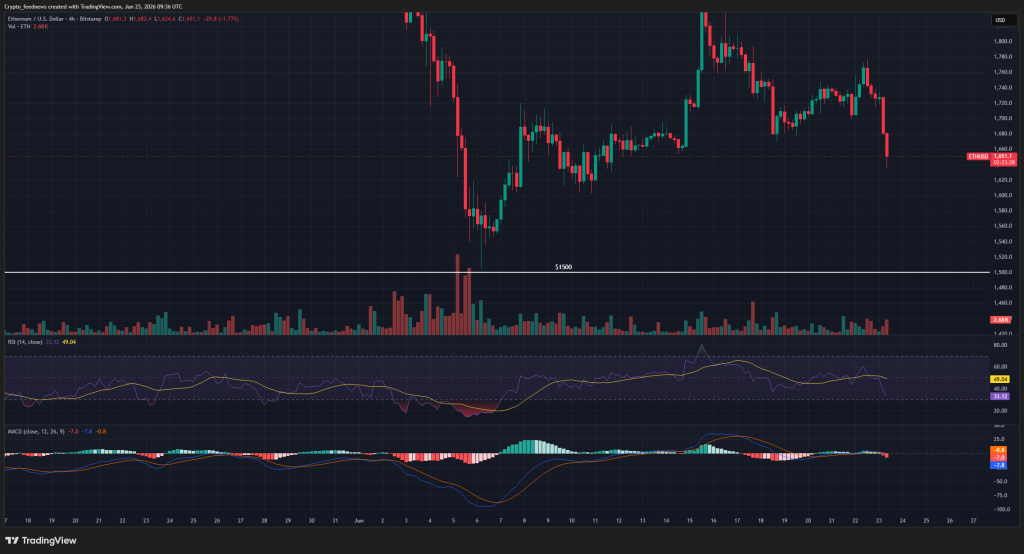
RSI stands near 33.56, below its moving average of about 49. The reading is not deeply oversold, but it remains below the neutral 50 line. That shows buyers have not taken control of momentum. Volume rose during the latest red candle, which suggests sellers stayed active around the current range. For now, RSI, volume, and Accumulation/Distribution do not confirm a strong recovery.
Derivatives activity contracts as Ethlabs launches
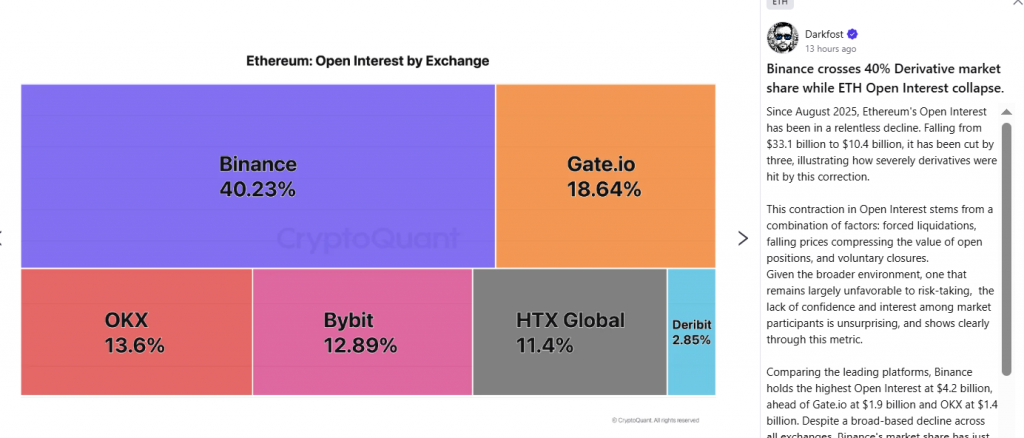
CryptoQuant analyst Darkfost said Ethereum open interest has fallen from $33.1 billion in August 2025 to $10.4 billion. The drop reflects liquidations, lower prices, and voluntary position closures as traders cut exposure.
Binance now holds about $4.2 billion in ETH open interest, ahead of Gate.io at $1.9 billion and OKX at $1.4 billion. Darkfost said Binance crossed 40% market share, showing that derivatives activity has become more concentrated even as the total market shrinks.
The weak derivatives picture came as Ethereum’s research ecosystem added a new group. Reports shows that Ethlabs launched with support from Joe Lubin, Bitmine, Sharplink, Anchorage, Octant, SNZ, and other ecosystem participants. Ethlabs will focus on settlement speed, network capacity, native asset issuance, cross‑chain interoperability, and Ethereum’s monetary design. The group includes five former Ethereum Foundation researchers and will operate as an independent research body.
The launch adds long‑term support for Ethereum development, but it does not change the near‑term price setup. ETH still needs stronger spot demand, improved ETF flows, and a clear technical breakout before the market can confirm a recovery.