

![An intricate financial infographic set against a dark, glowing digital network grid with integrated data blocks and market indicators, referencing the context of image_22.png. At the center, a huge, upwards-surging green chart arrow composed of interconnected data blocks propels a large physical coin with a distinct NEAR logo upwards. The arrow smashes through fragmented red blocks labeled 'MARKET SKEPTICISM' and 'VOLATILITY NOISE', including a block from image_22.png. The central coin is split to display the text: '+22% RALLY (A) [Confirmed]'. To the left, a detailed neon green text panel lists 'RALLY FACTORS: EVENT: Private Perps Launch (Focus), GROWTH DRIVERS: (High), ON-CHAIN ACTIVITY Drive'. Numerous supporting green callouts include 'ASSET POTENTIAL (Extreme)', 'MARKET TRUST (Unbroken)', 'FORECAST CONFIRMED (Extreme)', and 'GLOBAL DEMAND RISKS (Neutralized)'. A green neon panel on the right confirms the message with the text: 'STRATEGIC FORECAST: (Long-Term Growth Focus) / TARGET METRICS: (Confirmed High Safety Standards) / (GLOBAL DEMAND)' with a large green upward arrow. The primary gold headline at the top reads: 'NEAR PROTOCOL RALLY HITS 22% ON PRIVATE PERPS'. The entire image features complex candlestick charts, time markers, scattered physical tokens, and circuit-like data streams, referencing the aesthetic of image_22.png. All text is distinct, legible, and correct. The perspective is a dynamic 3/4 front view.](https://crypto-feed.news/wp-content/uploads/2026/09/Screenshot-2026-09-18-102153.png "Institutional Demand Fuel: NEAR Protocol Rally Hits 22% After Private Perps Launch")
NEAR Protocol rally lifted the token 26% to $3.45 on Thursday. Traders reacted to confidential perpetual trading powered by Hyperliquid.
During the rally, trading volume surged 120.4% to $1.24 billion. Meanwhile, the market cap rose to about $3.9 billion.
NEAR Protocol rally follows confidential perps launch
NEAR made perpetual positions confidential by default. Consequently, users can open leveraged trades without public blockchain exposure. The setup uses NEAR Intents and a private shard. Therefore, transaction details stay shielded from the public ledger.
Traders remain in control of their funds. In addition, position size and entry levels can stay hidden. Trading activity can also remain private.
Funding does not rely only on assets held on NEAR. For example, the interface supports over 35 blockchains. NEAR Intents acts as the router between chains. As a result, users avoid extra transfer steps across wallets.
Hyperliquid handles the underlying perpetual trades
Hyperliquid provides the perpetual futures market behind the product. According to data, the platform saw about $240 billion in perpetual volume. That figure covers the last 30 days.
Under the arrangement, NEAR supplies the privacy and cross-chain layer. Meanwhile, Hyperliquid handles derivatives execution. The product supports over 50 markets. Additionally, traders can use up to 40x leverage.
Hyperliquid is attracting interest beyond NEAR. Payward, Kraken’s parent company, announced plans for on-chain perpetual futures. These would target U.S. customers. The mechanism includes CFTC-regulated Bitnomial Exchange and Bitnomial Clearinghouse.
What’s next for NEAR price?
The token had traded below the $3 mark. Nevertheless, the recent announcement sparked a rally. This happened amid a bearish crypto market after the CLARITY Act failed.
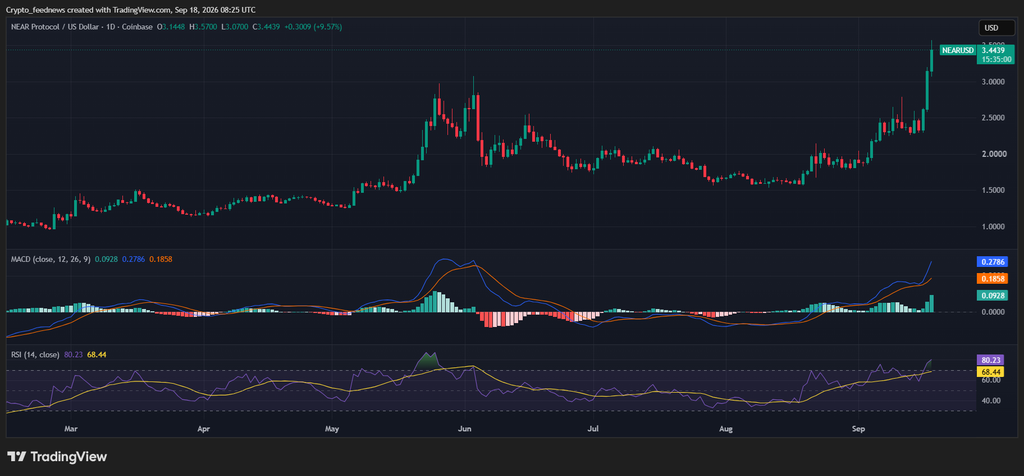
For the rally to continue, NEAR must reclaim $3.5. It must also maintain current momentum. Earlier in the week, interest in confidential trading was ramping up. On September 15, the project said its TVL reached $70 million.
However, perpetual futures remain a high-risk product. Leverage can magnify gains or losses. Local rules may also limit access. In some jurisdictions, decentralized derivative trading faces restrictions.