

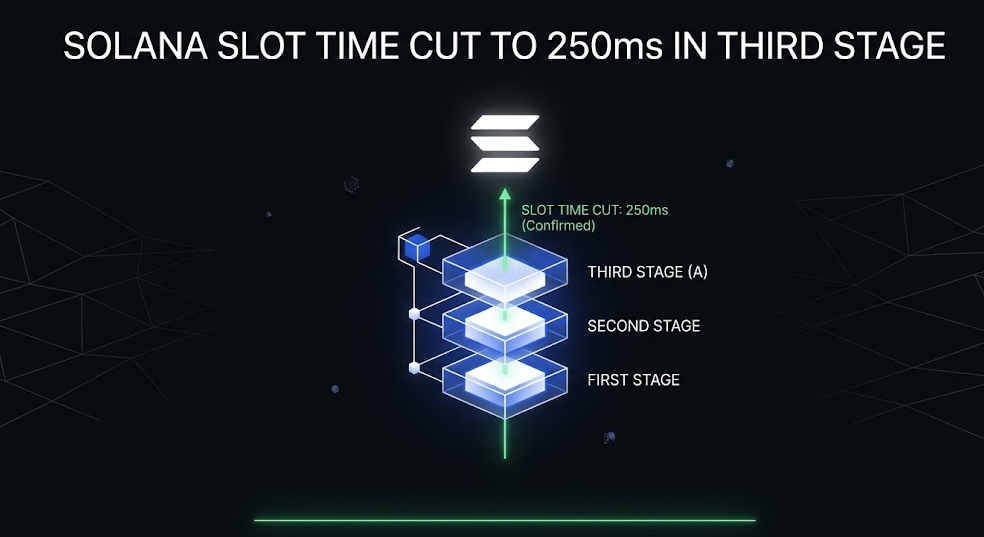
Solana slot time was cut from 300 milliseconds to 250 milliseconds. The change went live on September 18.
This increases slot production by nearly 17%. However, the overall processing ceiling does not rise by the same amount.
Why Solana slot time matters
The new setting brings Solana to four targeted slots per second. The previous 300ms configuration produced roughly 3.3. This is the third stage of SIMD-0525.
That proposal gradually reduces slot times from 400ms to a final target of 200ms. A slot is the period when a validator can produce a block. Therefore, shorter periods give wallets and exchanges more frequent updates.
Validators continue serving as leaders for four consecutive slots. With each slot at 250ms, the leader window falls from 1.2 seconds to one second.
Solana slot time reaches 250ms
Solana began this rollout in August. It cut its slot time from 400ms to 350ms then. This was the first reduction since the network launched.
SIMD-0525 divided the process into four stages. These are 350ms, 300ms, 250ms, and 200ms. Each reduction requires a separate feature activation. Consequently, developers can assess performance before moving ahead.
At 250ms, four slot opportunities arrive each second. Shorter intervals give applications a more current view. They also pass block production between validators sooner.
Oracle-based markets and automated market makers are covered by the proposal. Their operations depend on the age of onchain data. A shorter interval reduces time between network updates.
For swaps, the shorter timing narrows the period between submission and network arrival. The proposal identifies faster confirmations as a benefit.
The change does not boost raw capacity
This change does not increase raw transaction capacity by nearly 17%. Under SIMD-0525, resource limits fall in proportion to slot duration.
More slots are produced over a given period. However, each slot carries less computation and data. Therefore, total work over real time stays roughly the same.
At the 60 million compute unit baseline, the per-slot limit falls as the clock speeds up. The 250ms configuration corresponds to 37.5 million compute units. The planned 200ms stage would lower it to 30 million.
Faster blocks change infrastructure requirements
Infrastructure providers now have more blocks to process and store. The wall-clock processing ceiling remains broadly unchanged nevertheless.
Applications that calculate elapsed time may need adjustments. Blockhashes expire sooner in real time as slots advance faster. This leaves less time for offline signing or delayed approvals.
Epoch timing changes for the same reason. Solana keeps each epoch fixed at 432,000 slots. Therefore, an epoch becomes shorter as slot duration falls.
At the earlier 300ms target, an epoch lasted roughly 36 hours. The 250ms setting cuts it to around 30 hours. The final 200ms target would reduce it to approximately 24 hours.
Solana’s staged reductions form part of the Agave 4.2 rollout. The client release began activating several changes in August. These included lower storage rent and larger transactions.
The staged design includes a safeguard tied to block skip rates. Progress can halt if skip rates rise beyond acceptable levels. This gives validators time under each configuration.
No mainnet date has been set for the 200ms stage.
Solana upgrades extend beyond faster slots
Slot timing is only one part of the Agave changes. Solana separately introduced Transaction V1. This raises the maximum serialized transaction size from 1,232 bytes to 4,096 bytes.
The larger format accommodates data-heavy operations. These include zero-knowledge proofs and complex multisignature instructions.
Transaction V1 is optional. Legacy and version zero transactions remain supported. Applications that read blocks need to support the newer format.
The transaction size increase is separate from SIMD-0525. Larger transactions do not determine the slot clock.
Solana is still targeting 200ms slots
The final stage under SIMD-0525 would reduce slot time to 200ms. That would bring the network to five targeted slots per second.
A four-slot leader window would fall to roughly 800ms. Epoch duration would decline to approximately 24 hours.
Solana developers have not provided a mainnet activation date. Progress depends on network behavior under the current setting.
The slot reductions are separate from Alpenglow. That is Solana’s planned consensus redesign. Alpenglow targets roughly 150ms finality.
Its code has been included for testing. Mainnet deployment has been tied to Agave 4.3. Alpenglow entered community validator testing earlier in 2026. Anza described it as the largest consensus change in Solana’s history.
For SIMD-0525, the network remains at 250ms. The 200ms configuration would complete a rollout from 400ms. That rollout moved through 350ms, 300ms, and 250ms. Resource limits fell at each step.