

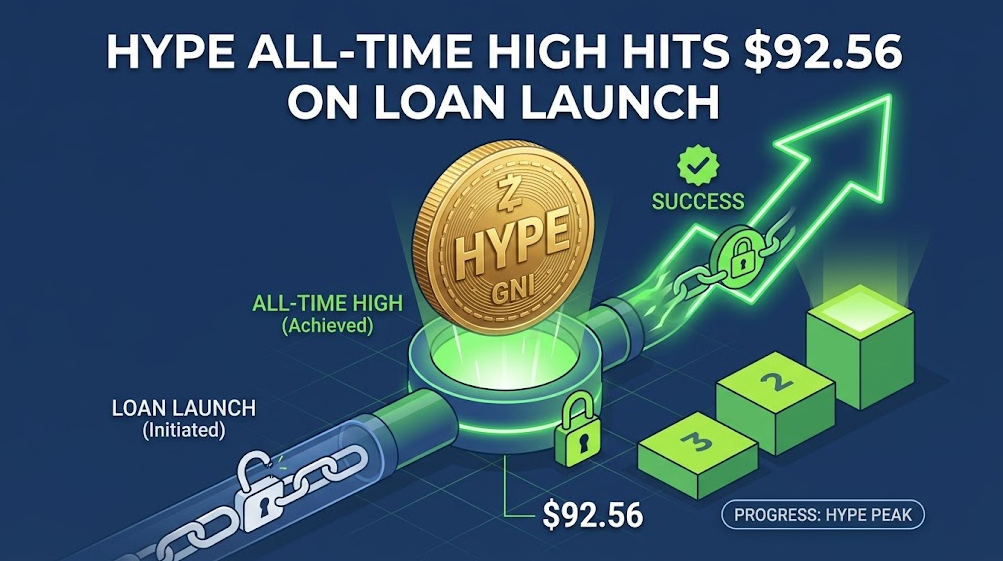
HYPE all-time high hit $92.56 on September 18. The token rose 10.5% to $91.20 after Hyperliquid launched a new feature.
Specifically, the platform introduced manual USDC and USDT borrowing. Users can now borrow against HYPE and Bitcoin collateral.
Why the HYPE all-time high matters
Hyperliquid’s documentation states manual borrowing went live on September 18. Users can borrow USDC and USDT after supplying collateral. The service runs through HyperCore. That is the same infrastructure supporting portfolio margin.
“Manual borrowing is supported for Manual/Standard and Unified Account users,” the platform said. Portfolio margin accounts already handle borrowing automatically. Therefore, the manual action is unavailable to them.
Manual and unified account holders can choose the amount. This is subject to available liquidity and limits.
Collateral rules and loan-to-value ratios
HYPE collateral has a 65% loan-to-value ratio. Therefore, $1,000 worth of HYPE provides up to $650 in borrowing capacity. Bitcoin has a lower 50% LTV. That gives the same collateral value up to $500.
When a user supplies both assets, Hyperliquid adds their contributions together. Supplied HYPE and Bitcoin do not earn interest. In contrast, supplied stablecoins earn interest. However, they do not increase borrowing capacity.
Borrowed stablecoins accrue interest continuously. The balance is indexed every hour. Rates depend on how much liquidity borrowers use. Suppliers receive a lower yield than borrowers pay.
Hyperliquid also retains 10% of borrower interest. This acts as a reserve for future liquidations. Data placed total borrowed assets at about $269 million.
Liquidation rules depend on collateral value
Hyperliquid uses a health factor. It compares LTV-adjusted collateral with outstanding debt. An account cannot take another loan once the health factor reaches 100% or lower. Crossing that level does not automatically trigger liquidation nevertheless.
Partial liquidation begins when borrowed value exceeds collateral value. This applies after the designated liquidation threshold. HYPE has an 82.5% partial liquidation threshold. Bitcoin has a threshold of 75%.
Falling collateral prices can increase liquidation risk. This happens even without more borrowing. Interest charges and collateral withdrawals also matter.
In one example, Hyperliquid used 100 HYPE worth $40 each. The loan was 2,000 USDC. The collateral provided $2,600 in borrowing capacity at 65% LTV. That left another 600 USDC available.
For that position, the account would reach partial liquidation at about $24.24. This excludes further interest.
HYPE price breaks above its previous record
TradingView data showed HYPE trading at $91.03 at press time. It was up 10.5% over 24 hours. The token moved between $81.70 and $92.56. The upper end set its latest all-time high.
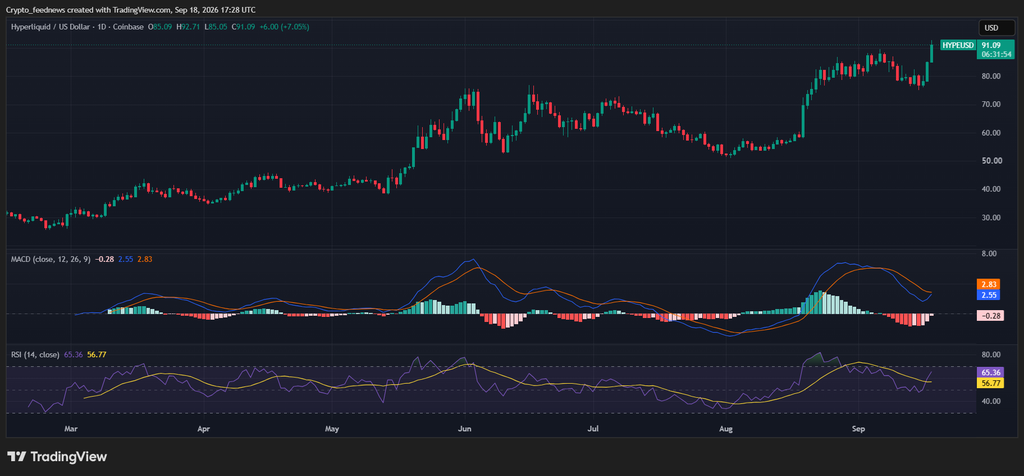
Trading volume reached approximately $1.72 billion. HYPE’s market capitalization stood near $20.3 billion. The token was also up 57.1% over 30 days.
The advance pushed HYPE above the $89.57 record set on September 6. Earlier, HYPE consolidated between roughly $84 and $88. Selling repeatedly appeared above $87 then.
HYPE later fell toward $78.70. Weaker momentum and legal concerns weighed on the market. It then reversed above $90 following the borrowing rollout.
Bitcoin rose alongside HYPE. It traded near $80,981 after gaining about 5.6%.
US access remains tied to regulated partners
Hyperliquid’s product range has grown. Meanwhile, connected companies pursue a regulated US route. The Hyperliquid Policy Center challenged CME’s lawsuit against the CFTC. That lawsuit concerns approval of a Kalshi Bitcoin perpetual contract.
In its September 9 filing, the policy group argued CME showed no competitive injury. It also said CME’s commercial interests fall outside the cited protections.
A separate proposal involves Payward, Kraken’s parent company. On September 16, Payward announced regulated Hyperliquid markets. These would serve eligible American clients through Bitnomial. The plan is subject to regulatory approval.
Under the structure, Bitnomial Exchange would administer selected perpetual markets. It would use Hyperliquid’s HIP-3 system. Bitnomial Clearinghouse would handle clearing and settlement. NinjaTrader Clearing would carry approved customer accounts.
US customers would need to complete onboarding. Their addresses would also need to appear on the permissioned allowlist. Payward said Hyperliquid would be the first protocol used. No launch date has been announced nevertheless.