


Saylor faces legal pressure after a shareholder rights firm opened an investigation into Strategy. This adds to mounting scrutiny that has accompanied the company’s sharp stock decline and Bitcoin’s latest selloff.
According to Rosen Law Firm, the investigation examines whether Strategy misled investors through materially inaccurate business disclosures. The firm evaluates potential securities claims and prepares a possible class action on behalf of shareholders who suffered losses.
Why Saylor faces legal pressure now
The announcement comes roughly a week after Bitcoin critic Peter Schiff publicly argued that investors in Strategy’s STRC preferred shares could have grounds for legal action. Specifically, this applies if they purchased the security based on Saylor’s promotion of the company’s Bitcoin‑backed investment strategy. Notably, Schiff’s remarks came before any law firm publicly disclosed plans to examine potential shareholder claims.
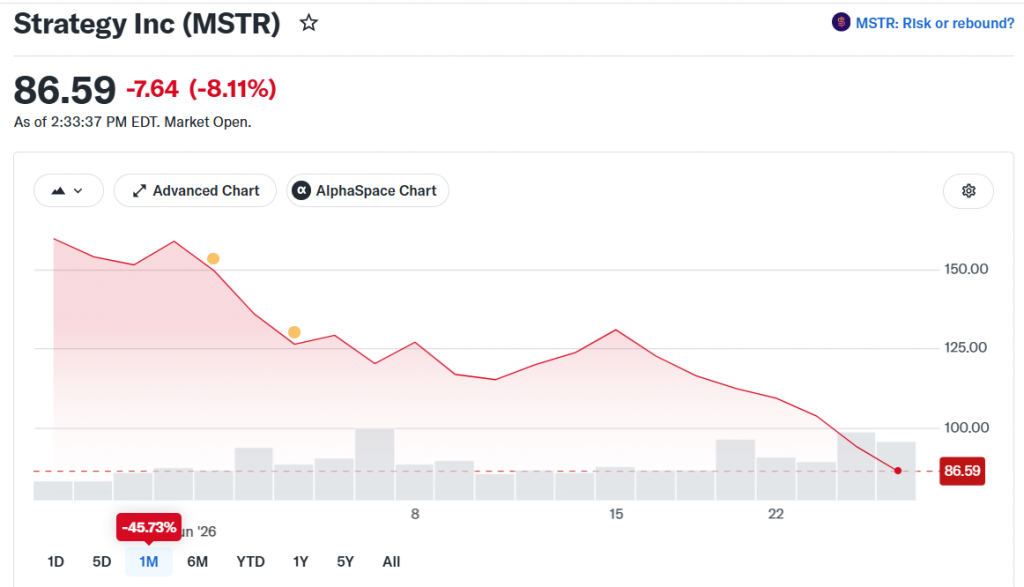
Meanwhile, pressure on the company has continued in the market. Yahoo Finance data show Strategy shares fell below the $100 threshold earlier this week before dropping to around $86 on Thursday. Consequently, the stock is down more than 6.5% on the day and about 23% over the past week.
Concerns expand beyond the stock price
Legal scrutiny follows growing criticism that had already surrounded Strategy’s Bitcoin treasury model. As previously reported yesterday, Schiff argued that continued weakness in Strategy’s shares could eventually force the company into difficult capital allocation decisions.
According to Schiff, persistent selling pressure from short sellers could make buying back Strategy shares more attractive than purchasing additional Bitcoin. He argued that selling part of the company’s Bitcoin holdings to finance stock repurchases could narrow the gap between Strategy’s market valuation and the value of its underlying assets. Nevertheless, he questioned whether such a move would be enough to restore investor confidence.
Schiff also warned that any sale of Bitcoin by Strategy could weigh on the cryptocurrency market itself. Specifically, it would add fresh supply during a period of weak demand.
Separate concerns have also come from on‑chain analytics firm CryptoQuant. The firm’s recent analysis urged Strategy to slow its pace of Bitcoin accumulation and rebuild liquidity instead. According to CryptoQuant, annualized dividend obligations tied to Strategy’s STRC perpetual preferred stock have climbed to about $1.2 billion. Meanwhile, the company’s cash reserves have fallen 38% during 2026.
Furthermore, CryptoQuant estimated that dividend coverage has dropped from more than seven years to roughly 14 months. The firm calculated that restoring coverage to 24 months would require approximately $2.8 billion in cash. That is nearly double the company’s existing reserves.
Management continues backing its Bitcoin strategy
Even as outside criticism has intensified, Strategy’s leadership has continued defending its long‑term Bitcoin approach. For example, Saylor recently pointed to conditions during the 2022 crypto bear market. At that time, Bitcoin traded near $16,000, and the company’s debt exceeded the combined value of its Bitcoin and cash reserves.
According to Saylor, the company’s financial position has since improved substantially. Specifically, Bitcoin and cash reserves now exceed outstanding debt by more than $40 billion. His comments indicate that Strategy does not intend to abandon its Bitcoin treasury strategy despite the latest market turbulence.
Meanwhile, additional selling pressure emerged during Thursday’s session. Market commentator Zerohedge claimed that unusually heavy put option buying in Strategy shares coincided with fresh weakness in both MSTR stock and Bitcoin.
At the same time, Bitcoin extended losses after U.S. Personal Consumption Expenditures inflation accelerated to 4.1%. That is its highest reading since 2023. Consequently, this adds another source of pressure for both the cryptocurrency and companies with large Bitcoin exposure.