

Fed October hike expectations fell after Vice Chair Philip Jefferson signaled patience. He spoke at the University of Virginia on October 1. He said future policy changes should depend on incoming data.
Jefferson said policymakers may need more time. “My colleagues and I will need to come to our own judgment,” he said. That judgment “may take more time.” His comments followed New York Fed President John Williams. Williams said another hike could be appropriate. However, he saw no urgency. Both officials vote on the FOMC.
Why Fed October hike expectations fell
Markets cut October hike odds to around 25%. Earlier, traders saw another move as much more likely. Consequently, attention shifted toward December. For Bitcoin, this removes some immediate policy pressure. Recently, high Treasury yields and oil prices limited BTC gains. Therefore, an October pause could remove one headwind.
Bitcoin entered October under pressure
Bitcoin entered October after struggling with higher U.S. borrowing costs. Spot ETF demand remained strong nevertheless. As previously reported, the 10-year Treasury yield reached 5.2% on September 24. At that time, Bitcoin traded around $84,000. It had pulled back from above $87,000.
Yields moved higher afterward. The 10-year yield climbed above 5.34% on October 1. Then it retreated toward 5.25%. Markets reassessed the likelihood of another immediate Fed hike. A lower October probability could ease pressure on Bitcoin. This depends on whether Treasury yields continue to retreat. Higher bond yields offer attractive returns on lower-risk assets. They can also make speculative assets less appealing. Rising borrowing costs can tighten financial conditions across markets.
Bitcoin showed sensitivity to yields
Recent trading showed how closely traders watch this issue. Bitcoin fell 4.3% to around $83,500 last week. During that period, the 10-year yield moved from about 4.95% to 5.20%. Meanwhile, crypto ETF inflows reached $2.39 billion for the week. Therefore, ETF demand stayed positive. However, higher yields worked in the opposite direction.
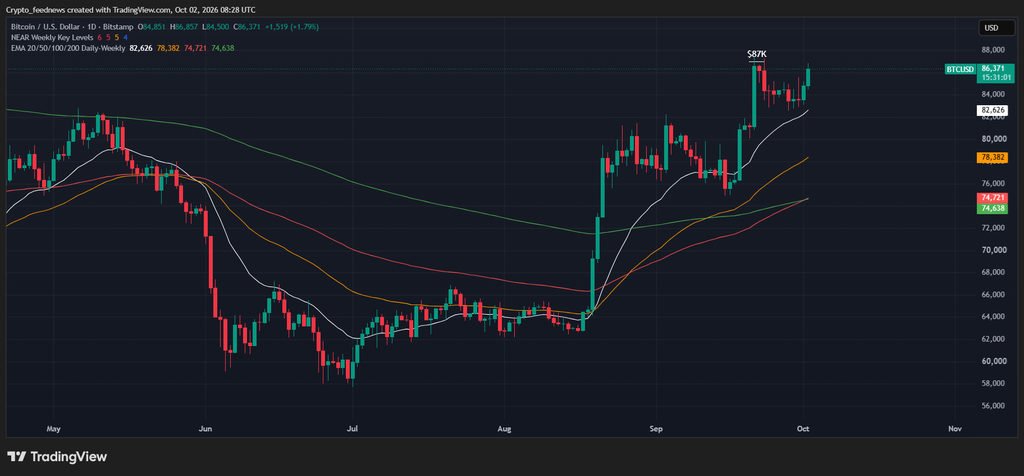
Bitcoin faced similar pressure earlier in September. A move toward $77,000 coincided with higher oil prices. Persistent U.S. inflation and rising Treasury yields also contributed. Meanwhile, the 50-week EMA emerged as important technical support.
Jefferson’s remarks leave room for rate pressure to cool. However, his inflation assessment gives the Fed little room. The Fed cannot declare the tightening cycle finished.
Jefferson still sees inflation risks tilted higher
Jefferson supported the Fed’s September decision. The Fed raised the federal funds target range by 25 basis points. That range became 3.75% to 4%. Jefferson said economic activity remained broadly solid. He also said labor market conditions remained solid. However, inflation continued to run above the 2% target.
Headline PCE inflation stood at 3.4% in August. Jefferson said energy prices drove the recent pickup. He pointed to volatile oil markets and global energy supply pressure. “I remain concerned about the risk of higher energy prices,” he said. That could lead to a persistent rise in inflation more broadly.
His base case expects inflation to remain elevated short term. Then it should move back toward 2%. That happens as energy and other price shocks fade. Risks around that forecast remain tilted to the upside. Geopolitical developments and stronger-than-expected demand drive that risk.
Jefferson said the Fed needs to determine underlying trends. Specifically, it must see whether inflation returns to target quickly enough. That determines the appropriate policy stance. For Bitcoin traders, this keeps December in play. An October pause would not rule out another hike this year.
Another Fed hike remains a macro risk
Another Fed hike is already a larger macro risk for Bitcoin. HashKey Group senior researcher Tim Sun recently said this. He said a second Fed hike could matter more than the stalled CLARITY Act. Sun said an October move would change how investors read September’s increase. Two consecutive hikes would indicate a more persistent tightening cycle. He identified Treasury yields as a key factor. He also cited spot Bitcoin ETF flows and derivatives leverage.
An October pause would break that sequence. However, it would not rule out another hike before year-end.
December Fed hike risk has not disappeared
Upcoming U.S. economic data will determine whether the Fed can remain patient. Jefferson expects real GDP growth to remain close to 2.4%. That was the first-half 2026 pace. He described the labor market as stable. The unemployment rate was 4.1% in August. That is near what he considers maximum employment.
Strong economic activity has come with inflation above target. Jefferson said short-term inflation expectations were elevated. However, most longer-term measures remained consistent with 2%. Oil remains another variable for inflation and Bitcoin. Higher energy costs can feed into headline inflation. They can reinforce expectations that rates remain elevated. Falling oil prices could reduce some pressure.
Bitcoin recently faced high Treasury yields and elevated oil prices. It also faced expectations for another Fed hike. Meanwhile, spot ETF demand provided support. Jefferson said he would continue assessing inflation progress. More incoming data will give policymakers a clearer picture. That data will shape the appropriate monetary policy stance.