

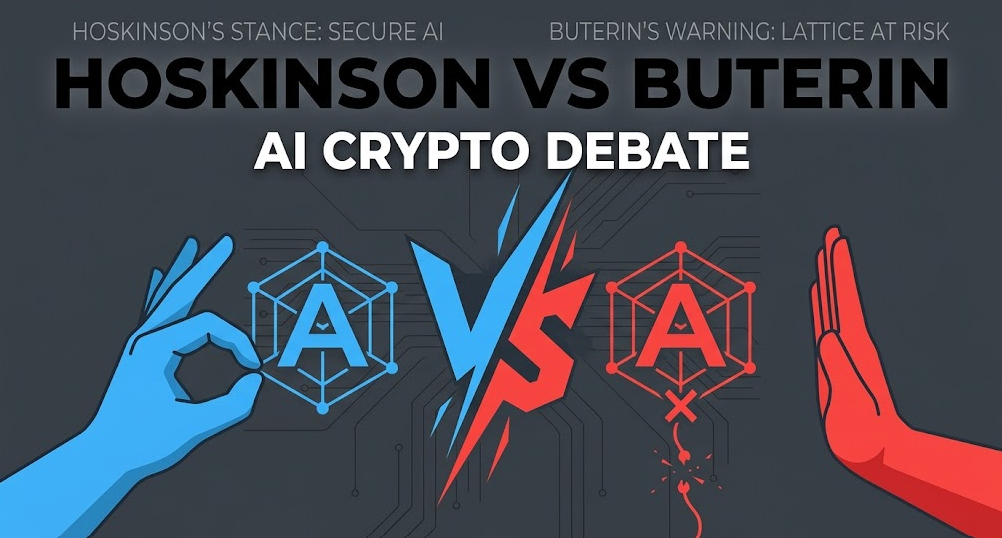
Hoskinson challenges Buterin AI warning over lattice cryptography. Cardano founder Charles Hoskinson responded to Ethereum co-founder Vitalik Buterin. Buterin warned that AI could weaken quantum-resistant cryptography.
Why Hoskinson challenges Buterin AI warning
Buterin said AI math could challenge lattice-based cryptography. He gave a two-year timeline. He warned that ML-DSA and FHE may be at risk. He challenged the assumption “elliptic curves broken, hashes safe, lattices safe.”
Hoskinson replied on October 9. He said the factoring analogy is wrong. He said no credible new attack was shown. Therefore, abandoning lattice methods is premature. He also opposed large key size increases without an identified attack.
Hoskinson challenges Buterin AI warning over factoring analogy
Buterin compared lattice risk to integer factorization improvements. Hoskinson rejected that comparison. He said factorization gains relied on specific techniques. Those techniques have not worked against lattice problems. He cited the LLL algorithm from 1982. He also cited decades of sieving improvements. Consequently, current parameters already account for known attacks.
NIST standards and AI risk
Hoskinson pointed to ML-KEM and ML-DSA. NIST standardized them in August 2024. They followed years of public review. He argued that structure alone does not make algorithms unsafe. Buterin suggested increasing lattice key sizes by ten. Hoskinson called that “numerology” without a specific attack. He said researchers must establish computational cost first.
Ethereum’s hash-based plan faces criticism
Ethereum’s Lean roadmap favors hash-based signatures. These include WOTS and SPHINCS. Buterin said hash-based methods may offer stronger long-term security. Hoskinson challenged that view. He noted that MD5 and SHA-1 were broken. He said SHA-256 lacks a mathematical proof. He questioned Poseidon and Poseidon2. Ethereum has moved to SHA-2 and BLAKE2s. Hoskinson said hash-based signatures cannot replace all public-key cryptography.
Wallet security debate grows
Ethereum Foundation researcher Justin Drake warned about AI attacks on wallets. He cited elliptic-curve cryptography. Buterin said take it seriously, but do not rush migrations. He advised using addresses with unexposed public keys when safe. BitGo tested ML-DSA wallet signing in May. Sui’s roadmap includes lattice and hash options. Hoskinson called for testing and cost analysis before changes.
What comes next
No Cardano upgrade or schedule was announced. Hoskinson wants any new attack tested and reviewed. Meanwhile, Buterin supports quantum-resistant plans for Ethereum. The debate will likely continue as AI and quantum research advance.