

Solana 200ms slots activation is set for Friday, October 9. Developers prepared the final stage of a network upgrade. The change targets 200-millisecond slots.
Anza develops Solana’s Agave validator software. Anza said the reduction from 250 milliseconds is scheduled for epoch 1053. That epoch should arrive around 15:00 UTC.
Why Solana 200ms slots matter
The upgrade would let Solana target five block production opportunities per second. That is twice the frequency of its original 400-millisecond setup.
The change follows three reductions since August. These occurred under SIMD-0525, a proposal to improve network response times. The proposal keeps overall computing capacity relatively stable.
Solana 200ms slots activation nears final stage
Solana began reducing target slot times on August 21. The network moved from 400 milliseconds to 350 milliseconds. A second reduction to 300 milliseconds followed on August 28. The target reached 250 milliseconds on September 18.
The latest stage would complete the planned sequence. It would reduce the time available for each validator to produce a block.
A slot is a short period when an assigned validator can process transactions. With shorter slots, wallets and exchanges receive new transaction information more often. The Solana Foundation says the reduction aims to improve latency. It also limits how long validators control block production.
Currently, validators produce blocks across four consecutive slots. At 400 milliseconds per slot, each validator had a 1.6-second window. Once the 200-millisecond target takes effect, that window lasts just 800 milliseconds. A shorter window could limit transaction delays or price differences across venues.
Compute limits adjust with faster slots
The network will maintain controls on computing work per block. At 250 milliseconds, a block can carry up to 37.5 million compute units. Under the final configuration, the limit falls to 30 million compute units.
Blocks will arrive more frequently. However, each block will contain proportionally less computing work. Therefore, the adjustment should keep theoretical processing capacity roughly unchanged.
The staged rollout includes safeguards. These can stop further reductions if skipped block rates exceed the permitted threshold.
Faster Solana blocks bring new demands for validators
The shorter slot duration requires validators to operate on a tighter schedule. This applies especially to those voting during every available slot.
Under the original 400-millisecond configuration, the network targeted 2.5 slots per second. At 200 milliseconds, the target rises to five. Validators voting on every slot would need to submit votes twice as frequently. Consequently, operating expenses could rise. Network connections may face more pressure.
Transaction processing presents another consideration. Solana transactions include a recent blockhash. This helps prevent replay of previously processed transactions.
Blockhashes remain valid for a limited number of recent blocks. As slots arrive more frequently, the real time available for a particular blockhash becomes shorter. Transactions requiring manual authorization or multiple signatures could face tighter deadlines.
Actual network performance will depend on validator responses. Solana Compass data from recent epochs showed average slot durations of about 266 to 269 milliseconds. That was under the previous 250-millisecond target. The difference shows the network has not consistently achieved its intended slot duration. Developers have deployed the 200-millisecond configuration on testnet and devnet. Mainnet performance will depend partly on missed production slots.
Solana’s Alpenglow upgrade remains separate
The latest slot reduction is taking place alongside another network change. That change focuses on transaction finality.
The Alpenglow consensus upgrade has reached Solana’s devnet and testnet. Developers are evaluating a system intended to reduce finality from about 12.8 seconds to around 150 milliseconds.
Unlike SIMD-0525, Alpenglow changes how validators agree that a block is final. The proposed system replaces TowerBFT with Votor. Votor is a voting mechanism designed to finalize blocks through one or two rounds of direct communication.
Solana’s mainnet continues to use TowerBFT. The Foundation has not confirmed a fixed activation date for Alpenglow. In September, developers prepared Agave 4.3 for consensus tests. Meanwhile, the slot reduction proceeded under a separate schedule.
The two upgrades address different parts of transaction processing. A faster slot target does not automatically mean 200-millisecond finality.
SOL price indicators remain mixed ahead of the upgrade
Solana’s native token traded near $109.65 on Friday. It was down approximately 2% over 24 hours. It also fell 7% over seven days.
Technical indicators showed mixed momentum. Specifically, there were eight bullish signals, eight bearish signals, and six neutral readings.
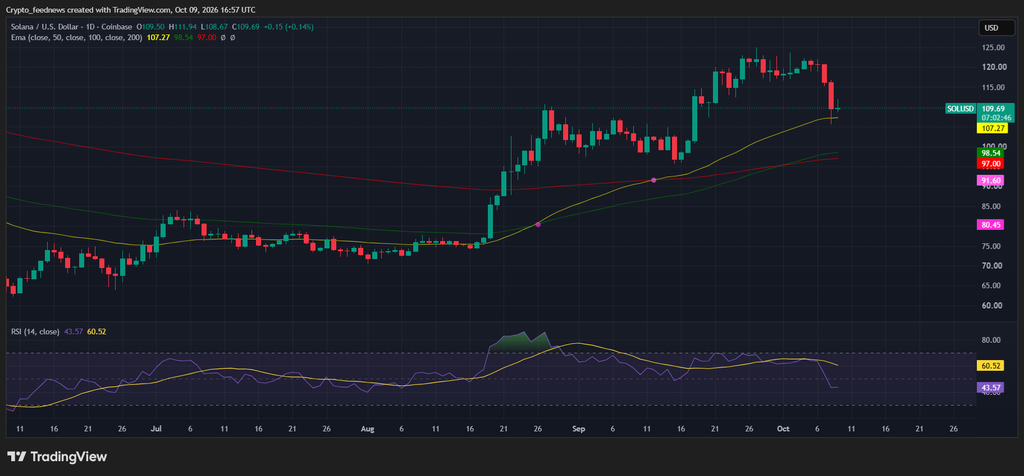
The 14-day relative strength index stood near 44. That is below the neutral midpoint of 50. It remains above the commonly watched oversold threshold of 30.
Moving averages presented a divided picture. SOL traded below its 20-day exponential moving average near $115.14. However, it remained above its 50-day EMA at approximately $107.31. It also stayed above its 200-day EMA near $97.07.
The readings indicated weaker short-term momentum. The token still remained above its longer-term moving averages.
Immediate resistance stood around $113.99. Another level followed near $119.82. On the downside, indicators identified support around $97.94. A sustained move above resistance would put the next level in focus. A drop below support could leave SOL exposed to further selling.
Institutional demand has cooled
Institutional demand has been another factor in SOL’s recent performance. An October price analysis noted that U.S. Solana exchange-traded funds attracted about $2,43 million during the preceding week. That compares with $188.1 million in the week before.
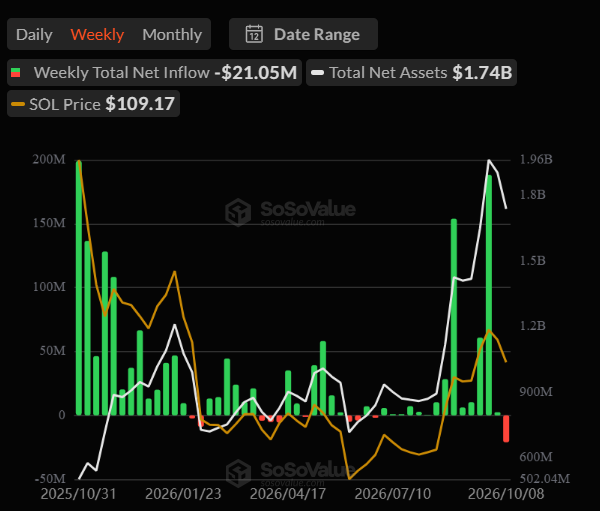
The slower inflows followed a period of stronger institutional buying. The Bitwise Solana Staking ETF surpassed $1 billion in assets in August.
Meanwhile, Solana’s 200-millisecond configuration has completed deployment on testing networks. Developers made the mainnet rollout conditional on network conditions. These include validator block skip rates. Activation is scheduled at the epoch 1053 boundary.
What comes next for Solana 200ms slots
The upgrade is set for October 9. If activation succeeds, Solana will target five slots per second. However, real performance depends on validators and skip rates. Therefore, traders will watch network data closely after activation.