

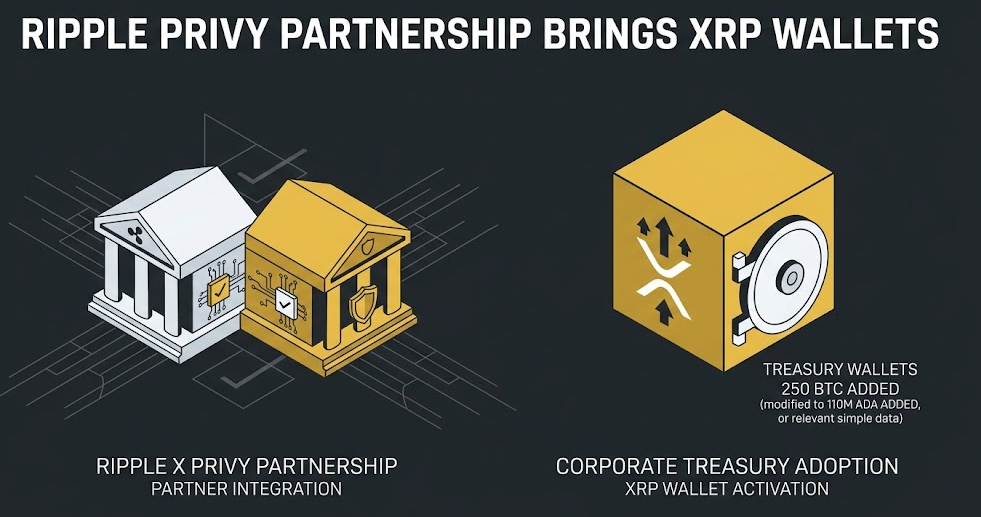
Ripple Privy partnership brings XRP and RLUSD wallet tools to apps on XRP Ledger. Consequently, developers can build payment services inside their applications. Ripple also says AI agents have made 13 million payments.
Why the Ripple Privy partnership matters
Stripe owns Privy. It announced the integration with Ripple. Specifically, Privy will bring programmable wallet infrastructure to XRP Ledger. Therefore, developers gain tools for consumer apps and AI agent payments.
Ripple Privy partnership brings wallets into apps
For businesses on XRPL, Privy handles wallet creation. It also handles wallet management and transaction signing. Consequently, developers can build around XRP and RLUSD. They can also use other ledger assets.
“With Privy, developers will be able to create and manage XRPL wallets programmatically,” the company said. They can “sign transactions, and build experiences using XRP, RLUSD, and other digital assets.”
Meanwhile, fintech companies can offer embedded wallets. As a result, customers avoid managing cryptographic keys. Privy places wallet functions inside the service. Developers still manage blockchain transactions.
In addition, Privy identified server-side wallets. For example, businesses can support AI agents. Those agents transact through payment systems like x402.
Markus Infanger is senior vice president of RippleX at Ripple. He said Privy’s infrastructure and XRPL’s settlement capabilities help developers. Specifically, he cited fast settlement and low transaction costs. He also noted native support for digital-asset transactions.
Ripple reports 13 million AI agent payments on XRPL
Ripple confirmed the partnership. It said AI agents processed 13 million payments on the ledger. That equals roughly 25% of network activity.
“To date, it has processed 13M agent payments,” Ripple said. Those payments “now account for roughly 25% of network activity.”
Previously, Ripple joined the x402 Foundation as a Premier Member. That happened on July 14. Ripple said its XRPL tools support AI-powered applications. Those apps settle transactions in XRP and RLUSD.
At launch, the Linux Foundation said it would oversee x402. Coinbase contributed the protocol. Under open governance, developers and financial companies can shape the standard. Ripple’s July announcement also named Stripe and Coinbase. Circle, Google, Visa, and Mastercard were also Premier Members.
Ripple released its XRPL AI Starter Kit in June. The toolkit helps developers integrate AI applications with the ledger. It supports software agents sending and receiving payments. Ripple-backed t54.ai also introduced an XRPL AI Hub.
Stripe acquired Privy after buying Bridge
Stripe agreed to acquire Privy in June 2025. That followed its $1.1 billion purchase of Bridge. Bridge is a stablecoin infrastructure provider. Bloomberg reported that Stripe did not disclose financial terms for Privy.
Privy launched in 2021. It supplied tools for companies to integrate crypto wallets. Its customers included OpenSea and Blackbird. They also included Toku. Under the deal, Privy continues operating independently. Bridge did the same.
Privy CEO Henri Stern described the problem. Developers had to send customers outside their apps. Those customers set up wallets elsewhere. Privy aims to fix that friction.
RLUSD gains custody support under separate plans
On October 12, Standard Chartered launched institutional RLUSD custody. It did so on XRP Ledger through its DIFC branch. Eligible clients can hold the stablecoin there. The Dubai Financial Services Authority regulates that operation.
Separately, Standard Chartered is working with Ripple and LMAX Group. They are exploring a collateral arrangement. Institutions could use eligible RLUSD holdings for trading. The tokens would remain in custody. Implementation depends on testing and final approvals.
A September 26 report placed RLUSD supply near $2.5 billion. DefiLlama figures placed XRPL stablecoins at about $1.19 billion. That included roughly $1.10 billion in RLUSD.
For U.S. holders, Standard Custody & Trust Company issues RLUSD. The New York State Department of Financial Services supervises it. Ripple says it holds reserves in segregated accounts. It publishes monthly third-party attestations. Direct purchases and redemptions require a customer agreement. RLUSD does not carry FDIC insurance. It also lacks SIPC protection.
What comes next for the Ripple Privy partnership
The partnership expands XRPL wallet tools for developers. It also supports AI agent payments. Meanwhile, RLUSD custody and collateral plans are advancing. Therefore, Ripple is building both infrastructure and institutional access. For now, developers can use Privy’s tools. They can build consumer apps and agent-based payment services.