


Bitcoin Bull Score has climbed to 90 out of 100. The reading followed Bitcoin’s latest rally above its 365-day moving average.
However, weakening spot and futures demand raise questions. Specifically, does BTC have enough buying support to resume its move higher?
Why Bitcoin Bull Score is at 90
CryptoQuant’s Bull Score Index jumped after Bitcoin broke above its 365-day moving average last week. The firm treats that level as confirmation of a bull market. Bitcoin traded just above $83,300 on Wednesday morning in Asia. It was up around 0.4% over 24 hours. However, it is down from its eight-month high near $87,400.
The Bull Score combines several on-chain and market indicators into one reading. The latest figure leaves Bitcoin only 10 points below the maximum score.
Price action has cooled since BTC reached its recent high. Bitcoin briefly moved above $87,000. Then sellers pushed it back toward $84,000. Meanwhile, resistance around $85,000 to $85,800 limited another move higher.
U.S. spot funds took in $999 million on September 21. They added another $714.7 million on September 22. That support helped the rally gather pace.
Bitcoin demand has fallen despite the Bull Score
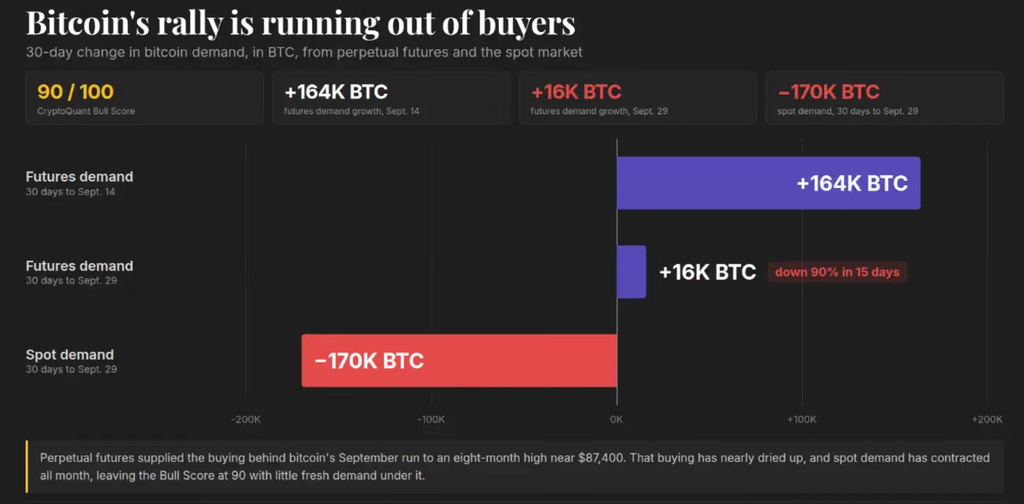
Demand data tracked by CryptoQuant has moved in the opposite direction. The firm estimates that Bitcoin spot demand contracted by roughly 170,000 BTC over the past 30 days.
Its apparent demand measure compares newly mined Bitcoin with changes in supply. Specifically, it tracks coins that have remained unmoved for at least one year. Apparent demand has contracted throughout the month. Therefore, the market has absorbed fewer coins than the amount becoming available.
The slowdown follows a period in which buyers helped Bitcoin break through several price levels. U.S. spot Bitcoin ETFs recorded $2.39 billion in weekly inflows. This covered September 21 to September 25. All five trading sessions ended with net inflows. BlackRock’s IBIT accounted for $1.16 billion of the total.
Exchange activity provided another sign of reduced supply. More than 13,800 BTC left Binance in one day last week. That was the exchange’s largest daily net outflow since 2023.
Binance Bitcoin reserves fell from around 705,000 BTC to 685,000 BTC over four days. Withdrawals can reduce readily available Bitcoin. However, exchange flow data does not reveal the purpose of those moves.
Futures demand has cooled much faster
Weakness is more pronounced in Bitcoin’s derivatives market. CryptoQuant estimates that growth in speculative futures demand fell from approximately 164,000 BTC on September 14. By September 29, it dropped to just 16,000 BTC. That decline amounted to roughly 90% in 15 days.
Leverage had already started leaving the market. This happened after Bitcoin failed to hold above $87,000.
Binance Bitcoin open interest dropped from approximately $5.4 billion to $4.9 billion. That happened between September 21 and September 23. Cumulative volume delta fell from nearly $3 billion to $1.48 billion during the same period. Funding rates moved close to neutral as leveraged traders cut exposure.
More recent data shows open interest falling while Bitcoin trades around $83,000. A reduction in leverage can remove liquidation risk. However, CryptoQuant’s figures show slower futures growth and contracting spot demand.
Profit taking adds another test for Bitcoin
Bitcoin’s recent rally left newer holders with sizable paper gains. According to CryptoQuant, recent buyers hold an average unrealized profit of 33%. That is the highest level since December 2024.
Some holders have already taken advantage of those gains. Investors realized profits on 25,700 BTC on September 22. That was the largest single day of profit taking recorded this year.
Bitcoin subsequently failed to maintain its move above $87,000. It returned toward the $83,000 to $84,000 region.
Long-term holder activity has shown profit taking as well. Recent CryptoQuant data showed long-term holders realizing profits while exchange reserves declined. Specifically, 12,153 BTC left trading platforms between September 17 and September 23.
Julio Moreno is head of research at CryptoQuant. He said further rallies would become harder to sustain without another pickup in buying. “Without fresh demand, rallies struggle to extend,” Moreno wrote. “With spot demand still in contraction and futures growth stalling, near-term upside becomes harder to sustain.”
Can Bitcoin continue higher with demand falling?
Bitcoin’s Bull Score and demand readings measure different parts of the market. The 90 reading shows most conditions remain consistent with a bullish market regime. That is especially true after Bitcoin moved above its 365-day moving average. The demand gauges track whether enough new buying is entering the market.
Price has already struggled around the area reached during last week’s rally. Bitcoin retreated from roughly $87,400. It traded near $83,300 on Wednesday. Therefore, the recent high is the first major area BTC would need to reclaim.
The $85,000 region has emerged as an immediate hurdle. Sell orders concentrated between $85,000 and $85,800 after the pullback. Bitfinex analysts identified a dense buyer cost area around $85,000 to $86,500.
The lower side of the range has become important as well. Bitcoin recently tested support around $83,000. Bitget Wallet research lead Lacie Zhang placed the key pullback area between $81,500 and $83,000.
Macro conditions remain another variable. U.S. Treasury yields have climbed to multi-year highs. Markets weigh persistent inflation and the prospect of further Federal Reserve tightening. The U.S. 10-year Treasury yield reached around 5.23% on Wednesday. It touched its highest level since 2007.
Traders now wait for the August personal consumption expenditures inflation report. The PCE index is closely watched by the Federal Reserve. It could influence expectations for the next interest rate decision.
Bitcoin therefore enters the inflation release with its Bull Score close to the top. However, spot demand is contracting. Futures demand growth is down roughly 90% in 15 days. Recent buyers also hold their largest average unrealized profit since December 2024.