

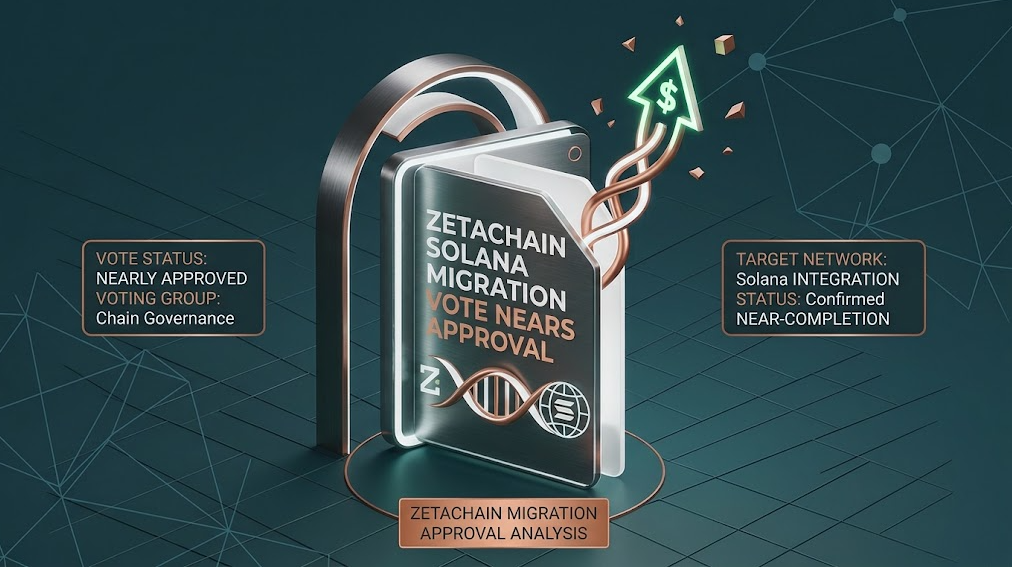
ZetaChain Solana migration moved closer to approval. Proposal 68 has 99.4% of votes supporting it.
The vote deadline is September 20. ZetaHub’s live tally showed 58% participation. That clears the 40% quorum requirement. Only 0.3% voted against, and 0.3% abstained. Voting closes at 14:58:18 UTC on September 20.
Why the ZetaChain Solana migration matters
The vote does not itself move ZETA. It also does not shut down the network. Instead, a successful vote authorizes core contributors. They would prepare a second proposal with the migration mechanism. That proposal would include the snapshot height and claim process. Exchange arrangements and the L1 halt schedule would also be included.
ZETA would move 1:1 to Solana without new supply
Proposal 68 would establish Solana as ZETA’s canonical network. ZETA would become a native SPL token. It would keep its existing ticker and total supply. Each holder would receive an equivalent amount through a 1:1 conversion.
One technical adjustment involves decimals. Native ZETA currently uses 18 decimal places. The proposed Solana token would use nine. Therefore, balances would convert from 18 to nine decimals. Any amount below the supported precision would be rounded down.
Existing vesting schedules would continue through their original dates. The project says no new tokens would be created. Each address would receive its corresponding balance based on the final snapshot.
ZetaChain’s September 17 announcement clarified something. ZETA already issued on Ethereum and BNB Chain is outside the proposal’s scope. The core vote concerns ZETA native to ZetaChain. It also concerns the future of the Layer 1 itself.
The project ruled out a wrapped representation. That would require tokens locked permanently on ZetaChain. Its proposal states that a bridge would depend on the original chain. The current plan eventually shuts that chain down.
Proposal 2 must approve the actual shutdown
A successful Proposal 68 would only approve the migration direction. ZetaChain validators would continue validating. Users could continue staking. Current balances would remain unchanged until another vote.
Core contributors would first coordinate with exchanges listing ZETA. The proposal says Proposal 2 will not be submitted until exchanges confirm their procedures. Platforms require advance notice before committing to migrations.
Proposal 2 would then establish the block height for the snapshot. It would also set the connected-chain withdrawal window and the chain halt. The Solana claim process and exchange conversion period would follow.
ZetaChain plans to publish the snapshot export and checksum. Balances could then be independently reproduced. An archive node and explorer would remain accessible after shutdown. Programs holding user ZETA during migration would undergo audits.
Staking rewards would continue until the shutdown time. ZetaChain has not finalized post-migration staking. It says the future mechanism remains “under active exploration.”
Anuma and 300,000 users form part of the plan
ZetaChain’s proposal reaches beyond its token. Anuma is its private multi-model AI application. The Private Memory Layer behind it would also move to Solana.
The company says more than 300,000 people have joined Anuma since February. The application passed one million requests across 35 AI models. Its published data showed 301,195 users through September 16.
Anuma uses encrypted memory under a user’s control. ZetaChain says closed model providers receive only required context. A private mode routes queries to open models using zero-retention infrastructure.
ZETA already has a utility role inside Anuma. Users can lock ZETA to receive credits. They then spend those credits on AI usage. Locked tokens are removed from circulating supply.
ZetaChain wants other Solana applications to connect to the same layer. The project said “running our own L1 no longer helps us build private AI.” It cited operating costs and security work as part of its case.
Security work helped shape the case for leaving
The proposal cites the maintenance burden inherited from Cosmos SDK. Its node repository confirms ZetaChain uses Cosmos SDK and Cosmos EVM. Therefore, its validator network must coordinate upstream upgrades and security patches.
The proposal refers to an August 25 security response. Cosmos Labs’ post-mortem found attackers exploited a vulnerability across six chains. This happened between August 20 and August 25. The incident prompted coordination with 40 networks.
The post-mortem does not identify ZetaChain as one of the six exploited networks. Therefore, the attacks should not be described as a ZetaChain exploit. The proposal cites upstream vulnerability management instead.
ZetaChain’s public GitHub work already shows migration-related engineering. An open pull request added tooling to export ZETA state. Its changelog includes emergency tooling for cross-chain shutdown procedures.
Solana infrastructure would replace ZetaChain validators
After migration and L1 shutdown, Solana validators would secure the network. ZetaChain would no longer maintain its own consensus set for the token.
The project cited Solana’s speed and transaction costs. Liquidity and agent infrastructure also mattered. Its September 17 announcement referred to 400-millisecond confirmations. It described sub-cent settlement as suitable for AI-agent transactions.
Solana has since activated another performance change. The network reduced its target slot duration to 250 milliseconds. The change raises the targeted slot rate to four per second.
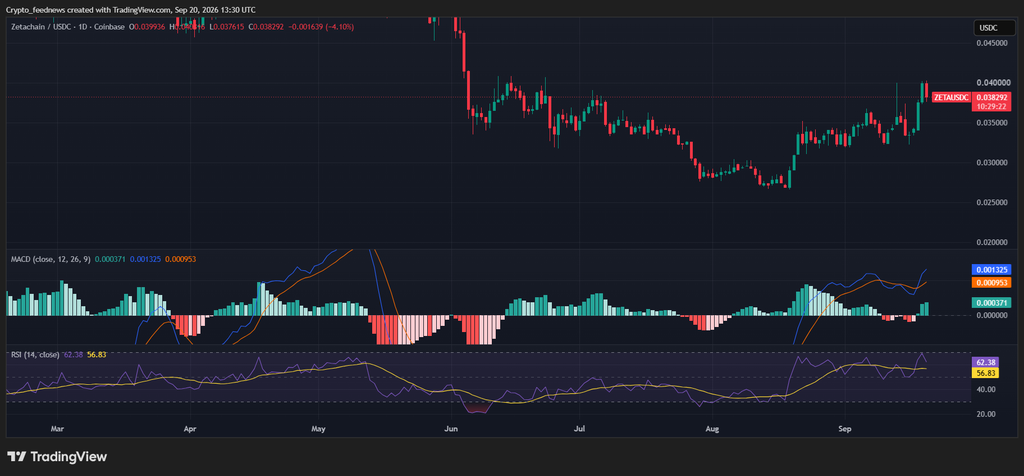
ZETA traded around $0.0342 on September 17. It closed near $0.0400 on September 19. That represents an increase of roughly 17%. The price data does not establish that the proposal alone caused the rise.
If Proposal 68 clears the vote, core contributors can proceed. They would coordinate with exchanges and prepare Proposal 2. Until that second proposal passes, the existing L1 remains in operation.