


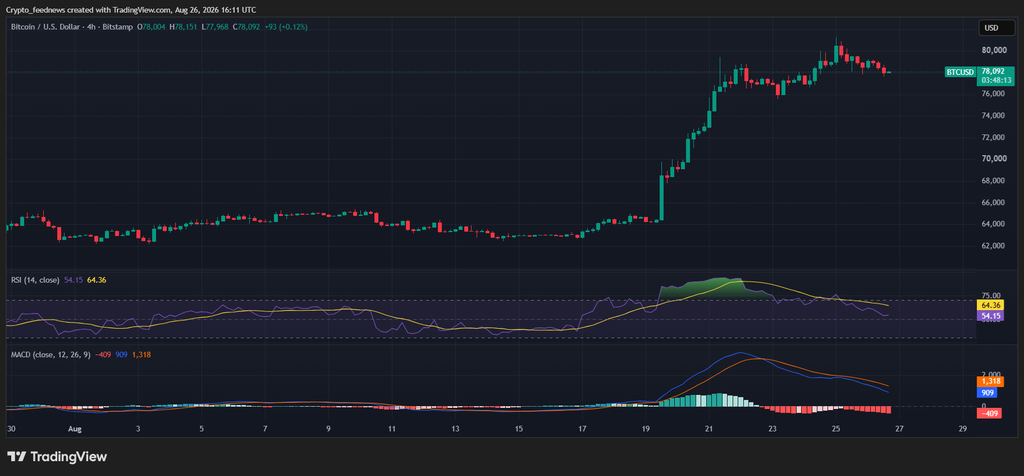
Bitcoin dips on hot PCE inflation data on Wednesday. BTC declined below $78,000 after the latest report revealed higher-than-expected price pressures.
The shift followed BTC’s breaching of the $80,000 level earlier in the day. This added to volatility dominating the markets prior to the key economic release.
Why Bitcoin dips on hot PCE inflation
Bitcoin recovered to $78,092 very briefly. Nevertheless, it was still 0.64% lower over the last 24 hours. Prior to the pullback, BTC hit an intraday high of $81,235.03. This was its first time trading above $80,000 since May.
The headline PCE price index went up 0.2% in July compared to the previous month. Economists expected a 0.1% monthly pick-up. PCE inflation was at 3.7% annually compared to the 3.6% forecast.
Core PCE (excluding volatile food and energy items) ticked up 0.2% month-on-month. This was in line with economists’ forecast. The annual core reading was unchanged at 3.3%, also on par with forecasts.
The inflation figures keep the Federal Reserve’s preferred gauge well above its 2% target. BEA data showed the annual PCE rate touched 4.1% in May. It is now back to 3.7%.
Impact on BTC and crypto
The stronger-than-expected headline reading triggered renewed pressure across risk assets. Traders assessed the implications for U.S. monetary policy. Treasury yields rose after the inflation release. Continued price growth could curtail room for looser monetary policy.
For Bitcoin, the inflation data came after a magnificent surge beyond $81,000. The current drop brought BTC back into the $78,000 range. This puts its recent rally to the test.
US Bitcoin ETF inflows support the spot-demand case
US spot Bitcoin ETFs recorded $314.3 million in net inflows on August 25. BlackRock’s IBIT led the session with $284.4 million. Seven consecutive positive trading sessions brought cumulative inflows to approximately $2.57 billion.
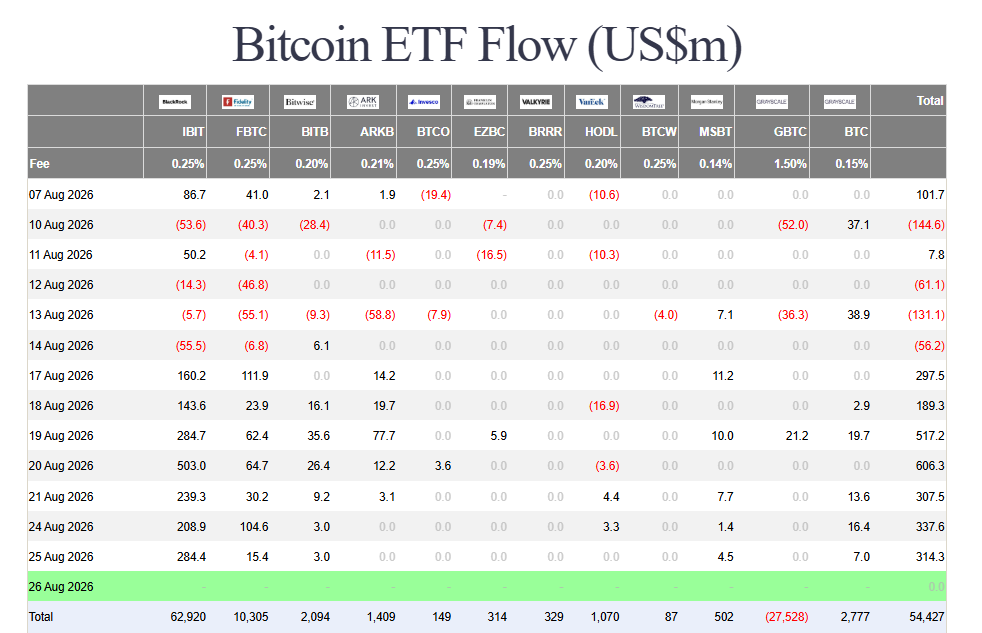
Bitfinex said the flow represented firm spot demand. This is not a rally sustained mainly by speculative leverage. Ko separately estimated the funds attracted roughly $1.9 billion during the week. He described it as the strongest weekly inflow of 2026.
“The question I care about most is whether this transitions from a derivatives-driven rally into a spot-driven one, and there are constructive signs,” Ko said.
Bitcoin must reclaim $80K to repair the breakout
Bitfinex analysts expect Bitcoin could consolidate between $77,100 and $80,000. It will then determine its next direction.
Immediate support sits between $77,800 and $78,000. Buyers responded during the latest decline. A sustained break below that area could expose $76,500 to $77,000. $75,700 to $76,000 would follow.
Bitcoin’s broader recovery would face a more serious test below $72,500 to $73,000. Ko identified the 200-day moving average around $69,000 to $70,000 as the main medium-term support. Bitcoin moved above it for the first time since November 2025.
On the upside, Bitcoin must reclaim the $79,200 to $80,000 region. This would weaken the failed-break structure. A close above $81,100 to $81,250 would provide stronger confirmation.
Ko identified May’s high near $82,000 as the next difficult barrier. Sustained ETF demand could support a move toward $85,000 to $90,000. The source of demand will determine whether the advance holds.