


Bitcoin options expiry approaches on Friday, August 28. Traders are preparing for approximately $6.44 billion in BTC options to expire.
The expiry covers about 81,700 contracts on Deribit. It happens at 08:00 UTC. Each contract represents one Bitcoin. Nevertheless, its notional dollar value changes with the underlying market price.
Why Bitcoin options expiry matters
Bitcoin traded near $78,970 at the time of reporting. It is down approximately 1.4% over 24 hours. Nevertheless, it is still 22.9% higher across seven days. Its daily range extended from about $77,955 to $80,194.
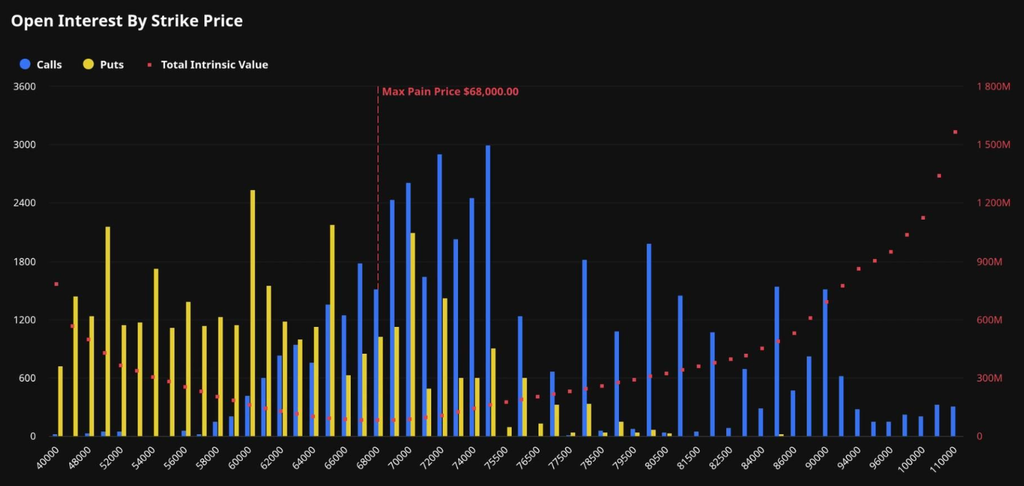
The expiring contracts include 44,639 calls and 37,061 puts. The put-to-call ratio is 0.83. This shows calls outnumber puts. Nevertheless, the ratio alone does not prove traders expect Bitcoin to rise.
Some call positions may form part of market-neutral strategies. Covered positions or volatility trades are also possible. Puts can represent portfolio insurance instead of direct bearish bets.
Gamma hedging could strengthen short-term price swings
The $75,000 strike carries the largest reported call concentration. It has approximately $236 million in notional value. The $80,000 call strike follows with about $157 million.
Bitcoin’s rally placed calls with strike prices below the market price in the money. Their holders can exercise the contracts profitably at expiry. This is subject to premiums and other trading costs.
The concentration near $75,000 and $80,000 makes those levels important. Dealers manage their exposure around these levels. Nevertheless, options positioning does not establish guaranteed support or resistance.
Market makers commonly hedge options exposure by buying or selling Bitcoin. They may also use futures or other linked instruments. Their required hedge changes as Bitcoin approaches a heavily populated strike.
This process is known as gamma hedging. Depending on dealers’ net positioning, hedging can restrain Bitcoin near a strike. It can also add momentum when the price moves decisively through it.
Deribit Chief Risk Officer Shaun Fernando said more than $500 million in notional value sits within 5% of Bitcoin’s market price. This concentration “should result in increased gamma hedging in the build-up to expiry.”
Fernando added that the positioning “may result in unusual pinning around key strikes or accelerate moves through them.” These outcomes remain scenarios rather than confirmed forecasts. The direction of dealer hedging depends on positions not fully visible through aggregate open-interest data.
Deribit volatility readings changed after Bitcoin’s rally
Fernando said nearly 20% of Deribit’s Bitcoin options open interest is scheduled to expire. He also reported a 30% relative increase in the Deribit Bitcoin Volatility Index (DVOL) during the preceding week.
The volatility term structure moved from backwardation to contango. Near-term implied volatility had previously traded above longer-dated volatility. This reflected demand for immediate protection. Contango means longer-dated contracts now carry higher implied volatility than shorter maturities.
Call-put skew also moved from negative to positive. This shows traders assigned relatively higher implied volatility to calls than comparable puts. The change followed Bitcoin’s fast recovery and rising demand for upside exposure.
Bitcoin climbed above $76,000 as ETF inflows accelerated. U.S. spot funds attracted about $1.1 billion across August 19 and August 20. BTC broke from its earlier trading range during that period.
The rally later stalled above $81,200. In related coverage, Bitcoin retreated toward $79,250 as momentum became overbought. Liquidation clusters developed near $78,000 and between $81,000 and $82,000.
Max pain does not guarantee a move toward $68,000
The expiry’s max-pain level stands near $68,000. Max pain estimates the settlement price where the largest amount of options value would expire worthless. This produces the lowest aggregate payout to holders.
The calculation often attracts attention before large expiries. Nevertheless, it is not a reliable price target. It does not account fully for hedging, contract purchase prices, or positions held outside one exchange. Spot demand or changing macroeconomic conditions are also not considered.
Bitcoin is trading approximately $11,000 above the reported max-pain level. Reaching $68,000 before settlement would require a much larger move. This is much larger than simply returning to the main $75,000 and $80,000 strike clusters.
The confirmed deadline is Friday at 08:00 UTC. Traders will watch whether Bitcoin remains near $80,000. They will also watch if it retreats toward $75,000. A break beyond the concentrated strikes is also possible as expiring positions and dealer hedges are closed or rolled forward.
Volatility can also fall after settlement. Near-term hedging demand disappears once the expiry passes. The expiry’s size raises the possibility of larger intraday swings. Nevertheless, it does not determine Bitcoin’s direction.